

How to Make a Shotgun Fruiting Chamber
A Shotgun Fruiting Chamber (SGFC) is a simple, low-cost setup used for growing mushrooms. It provides the right humidity and air exchange for mushroom fruiting. Here’s how to build one:
Materials:
Large clear plastic storage tote (about 50-60 liters)
Perlite (used for moisture)
Drill with 1/4-inch drill bit
Spray bottle (for misting)
Mushroom cakes or trays (e.g., PF Tek cakes)
Rack or shelf for inside the chamber (optional)
Steps:
Prepare the Container:
Choose a large, transparent plastic tote with a lid. The chamber needs to let in light for mushrooms to grow.
Drill 1/4-inch holes on all six sides (including the bottom and lid). Space the holes about 2 inches apart, creating a grid pattern. These holes allow for air exchange.
Prepare the Perlite:
Soak perlite in water. Drain it so that it's wet but not soaking. Perlite will provide the necessary humidity for your mushrooms to grow.
Spread about 4-5 inches of wet perlite evenly on the bottom of the tote.
Place a Rack or Shelf (optional):
If you want better airflow around your mushroom cakes or trays, place a small wire rack or shelf inside the chamber, above the perlite layer.
Place Mushroom Cakes:
Place your fully colonized mushroom cakes (from the PF Tek method or other substrates) on the perlite or on the rack, leaving space between them for airflow.
Maintain Humidity:
Mist the inside of the chamber (not directly on the cakes) with a spray bottle 2-4 times daily to maintain high humidity levels (85%-95%). Be careful not to overwater the perlite.
Fan for Air Exchange:
Fan the chamber by removing the lid and gently waving a piece of cardboard or the lid itself to encourage fresh air exchange. Do this 2-3 times daily to provide oxygen and encourage fruiting.
Provide Indirect Light:
Place the SGFC in an area with indirect light or use a small daylight spectrum lamp. Mushrooms need light to grow, but not direct sunlight.
Monitor and Harvest:
Keep an eye on the humidity, misting and fanning as needed. Within a week or so, mushrooms should start to form, and you'll be able to harvest them once mature.

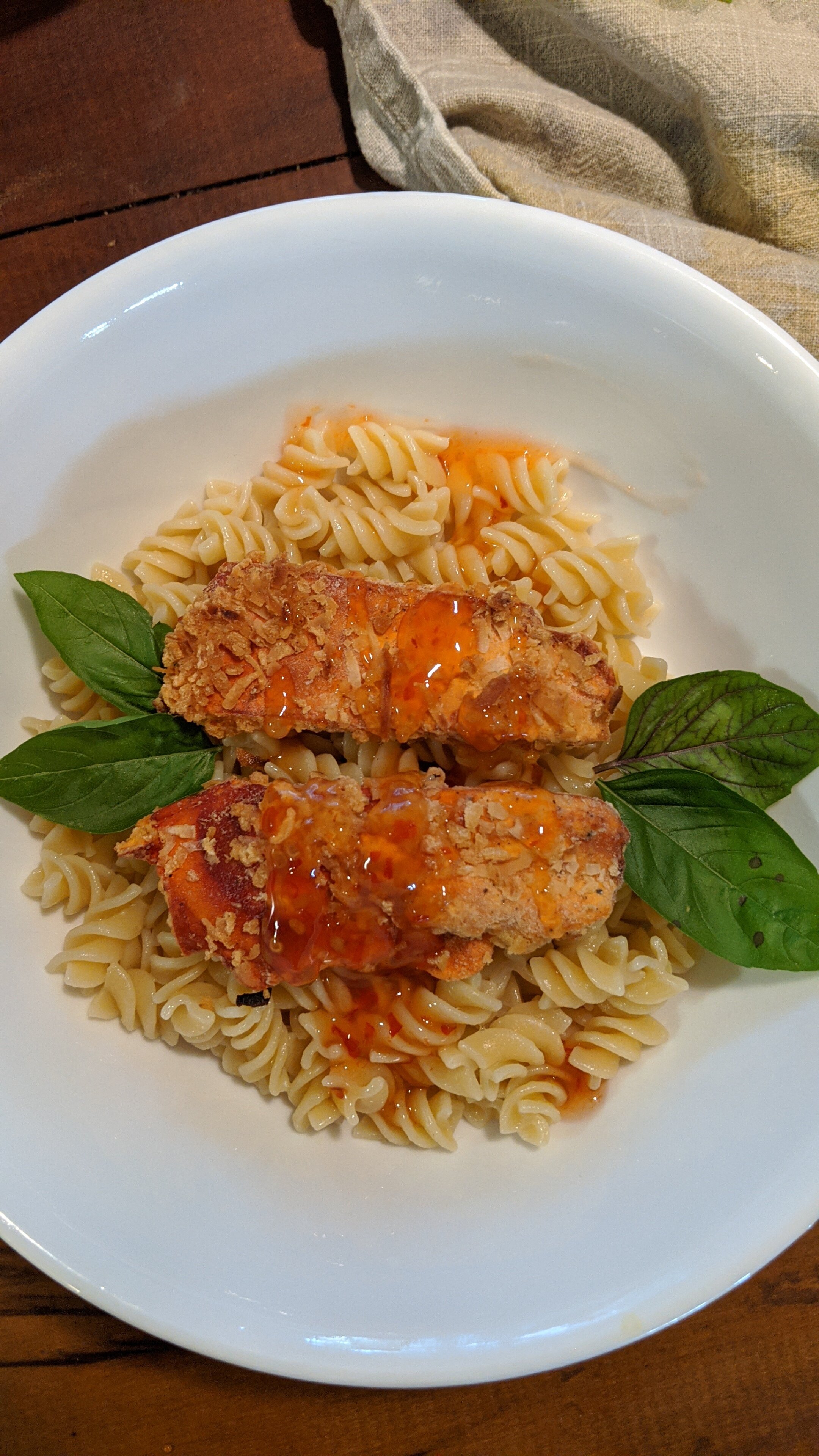
Recipe: Coconut Chicken of the Woods
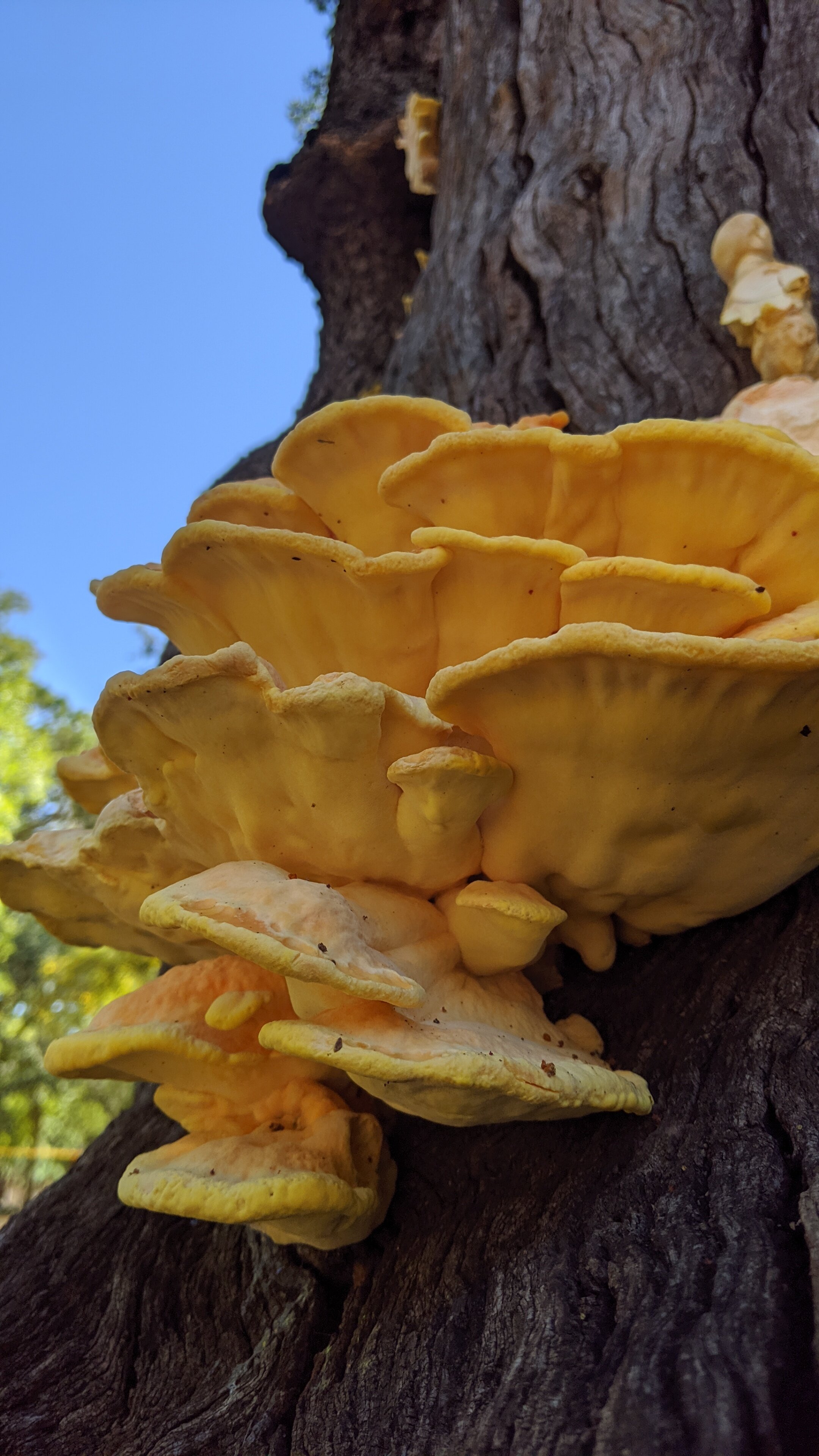
Coconut Chicken-of-the-Woods is a delicious way to prepare this choice edible mushroom.
Chicken of the Woods or Laetiporus species is choice edible and is highly nutritious fungi making it a great addition to a meat free diet. 100g of the mushroom contains 14g of protein, 6g of carbs, 3g of fiber and 150mg of potassium. In addition, it is rich in antioxidants, including flavonoids and phenols. These antioxidants have many medicinal benefits, such as anti-inflammatory, anti-viral, and anti-cancer properties. Since it doesn’t have any toxic look-a-likes, it is also a safe and mushroom to forage for beginners.
Coconut Chicken-of-the-Woods is my favorite way to prepare it.
Ingredients
1/3 cup all-purpose flour or whole wheat flour (spoon & leveled)
1/2 teaspoon salt
1/2 teaspoon ground black pepper
1/2 teaspoon red pepper
2 large eggs, beaten
3/4 cup Panko bread crumbs
1 cup sweetened shredded coconut
1 pound Chicken-of-the-Woods
Coconut Oil (Enough to fill frying pan 1 inch)

Instructions
Hand pull mushroom into strips or nuggets.
Dry sauté the pieces with 1/4 cup of water, salt and vinegar in a fry pan until water is absorbed or for 15 minutes. Drain excess water and use for broth, etc.
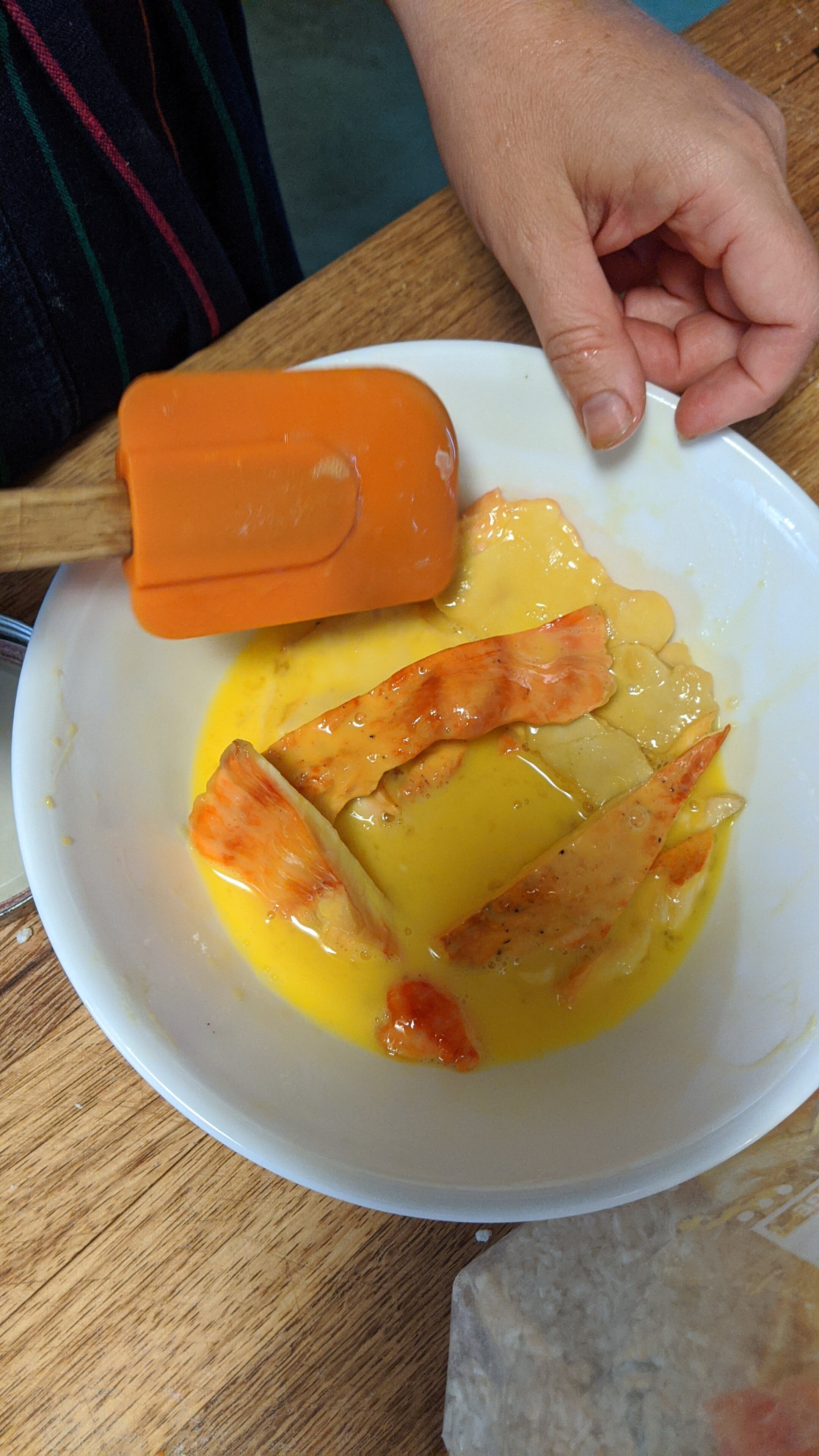
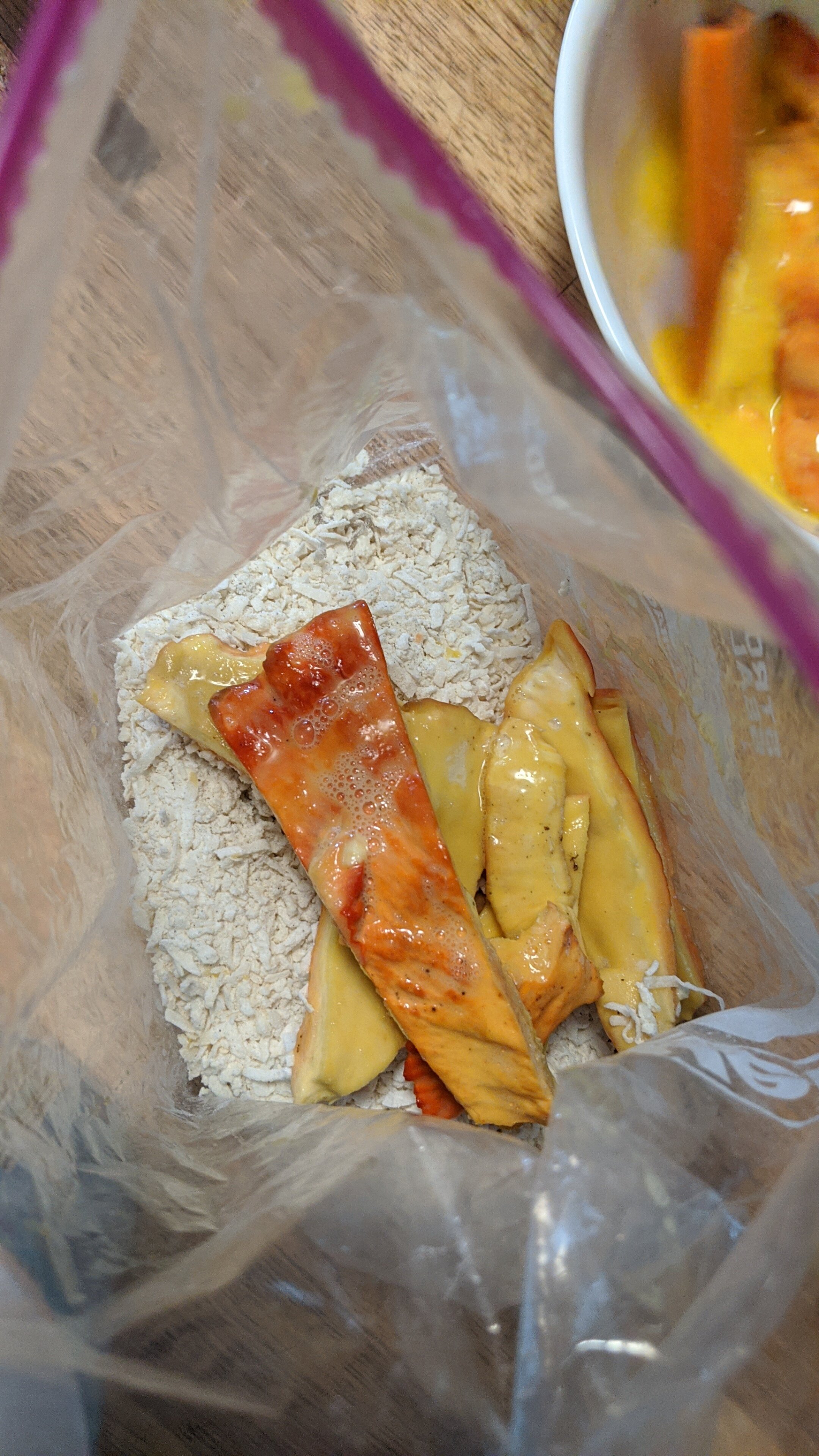
Combine flour, salt, and spices in one bowl. In a second bowl beat the eggs. Combine panko and coconut in the third bowl or large plastic freezer bag.
Dip the COW into the first bowl of flour and spices, then dredge in eggs, and then put the COW into the coconut and panko breading that is in a freezer bag and shake up.
Set the coated COW aside on a plate as you coat the remainder.
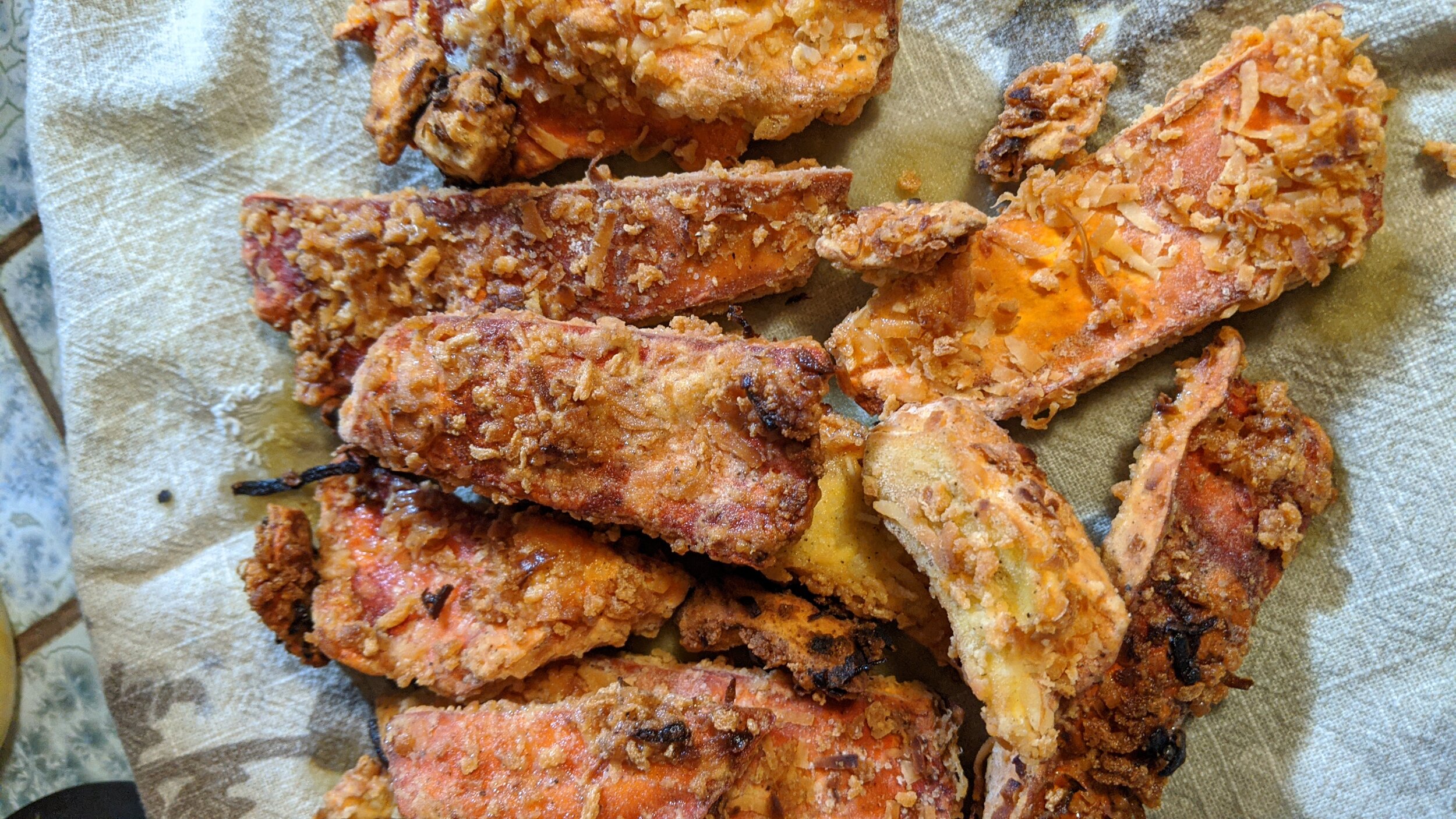
Add enough oil to cover the bottom of a large skillet on medium heat. Fry the coconut COW in batches – do not crowd them in the pan. I fried about 6-7 at a time. Flip after 2 minutes and fry the other side for 2 minutes or until golden brown. I like mine a little darker, so I fried each side for about 3 minutes.
Place the finished coconut COW on a plate lined with a towel as you fry the rest. Serve with your favorite sweet Thai chili sauce or an orange chili sauce.
Serve on top of your favorite pasta (optional) and sprinkle with a little chopped cilantro or basil (optional) and serve.
About Chicken-of-the-Woods
Scientific Name: Laetiporus sulphureus
Common Name: Chicken-of-the-Woods, Sulphur Shelf
Family: Polyporaceae
Description: Orange to yellow polypore, with yellow or white pores on underside.
Habitat: Grows in shelfs on heartwood of dead or dying oaks.
Spore Color: White Size: 6-12" width
Edibility: Contains proteins, fat, fiber and tastes just like chicken! Harvest when young, colorful, and moist. Becomes lighter in color, fiborus, mealy and dry, inedible with age.
Look-alikes: Shaggy Bracket, Inonotus hispidus (non-toxic)
Learn more about foraging it here.

October Mushroom of the Month: Laetiporus sp
The Mushroom of the Month for October is Laetiporus, aka Chicken of the Woods

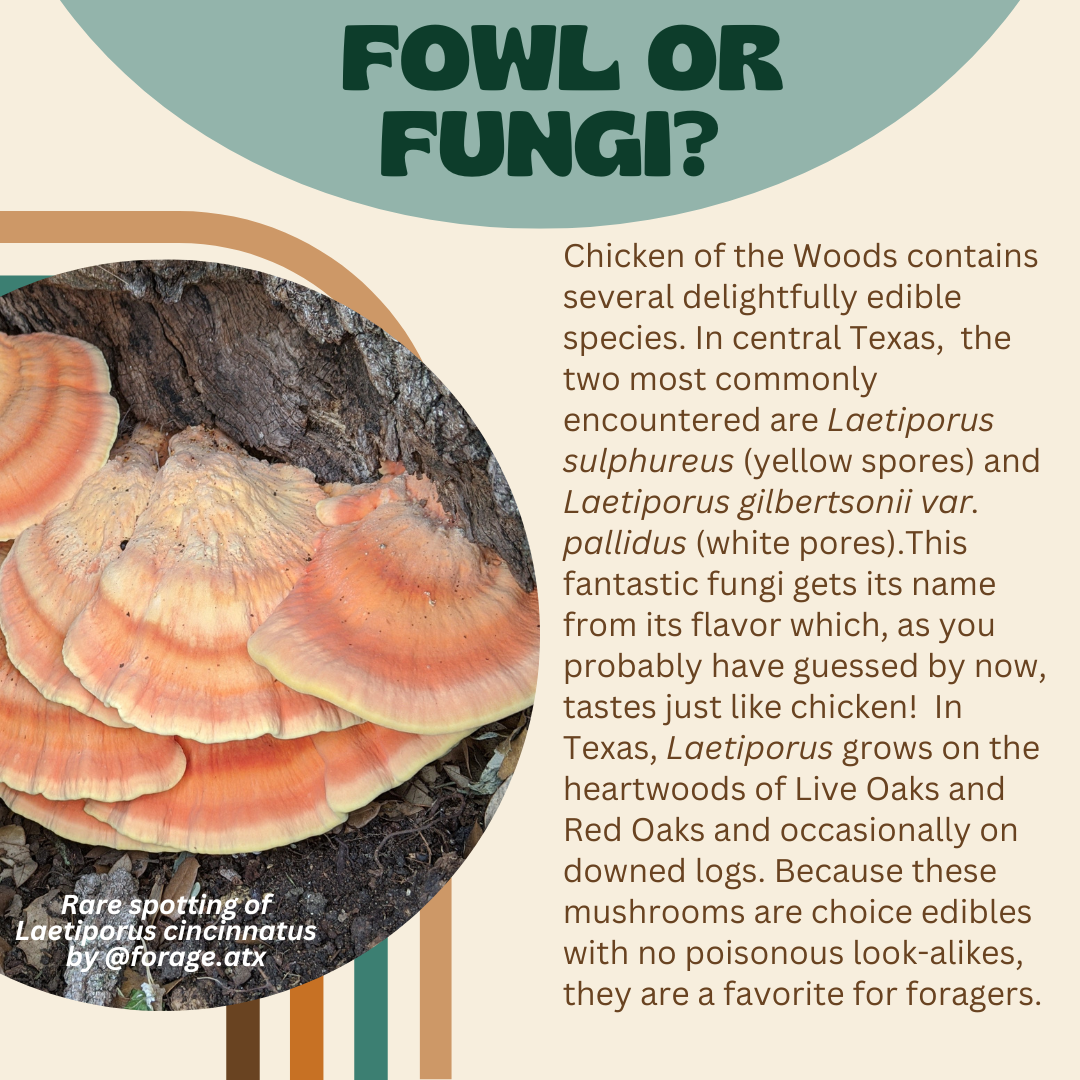


🐔🍄🌳The October mushroom of the month is 𝘓𝘢𝘦𝘵𝘪𝘱𝘰𝘳𝘶𝘴 commonly known as Chicken of the Woods! This choice edible mushroom that can be found perching in oak trees in the fall.
🙌 to Barb Danko for naming that mushroom correctly and becoming the 1,312th member of Central Texas Mycology!
You can also be a supporting member to stay dialed-in with events & discover next month’s mystery mushroom.
FOWL OR FUNGI?
Chicken of the Woods contains several delightfully edible species. In central Texas, the two most commonly encountered are Laetiporus sulphureus (yellow spores) and Laetiporus gilbertsonii var. pallidus (white pores).This fantastic fungi gets its name from its flavor which, as you probably have guessed by now, tastes just like chicken! In Texas, Laetiporus grows on the heartwoods of Live Oaks and Red Oaks and occasionally on downed logs. Because these mushrooms are choice edibles with no poisonous look-alikes, they are a favorite for foragers.
FRIEND OR FOE?
Despite their popularity amongst fungal enthusiasts, Laetiporus is considered to be a nuisance by some arborists. This is mostly due to its status as a parasitic species that promotes brown rot in its host. However, evidence has shown that Laetiporus does not live up to its bad rap. In fact, Laetiporus is actually a cubical brown rot fungi (slow decomposer) and provides habitat for bees and other creatures as it slowly decomposes trees. It has been found growing on thriving 500+ year old live oak trees, proving that the relationship between fungi and host may be more symbiotic than parasitic.
edible + Medicinal
Chicken of the Woods is a highly nutritious fungi making it a great addition to a meat free diet. 100g of the mushroom contains 14g of protein, 6g of carbs, 3g of fiber and 150mg of potassium. In addition, it is
rich in antioxidants, including flavonoids and phenols. These antioxidants have many medicinal benefits, such as anti-inflammatory, anti-viral, and anti-cancer properties. Since it doesn’t have any toxic look-a-likes, it is also a safe and mushroom to forage for beginners.
BECOME A SUPPORTING MEMBER & stay Dialed in with events & discover next month’s mystery mushroom

Benefits of Green Mold, AKA Trichoderma Fungi
Trichoderma or Green Mold is a soil dwelling fungi found all over the world that causes problems in sterile mushroom farms. If a mushroom block has green mold growing on it, it’s not a loss. It actually benefits plants in the following ways:

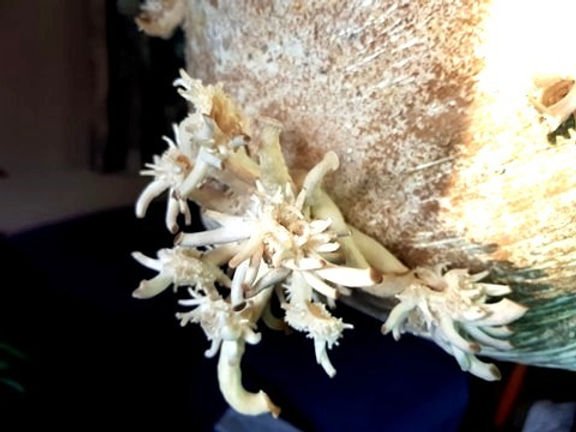
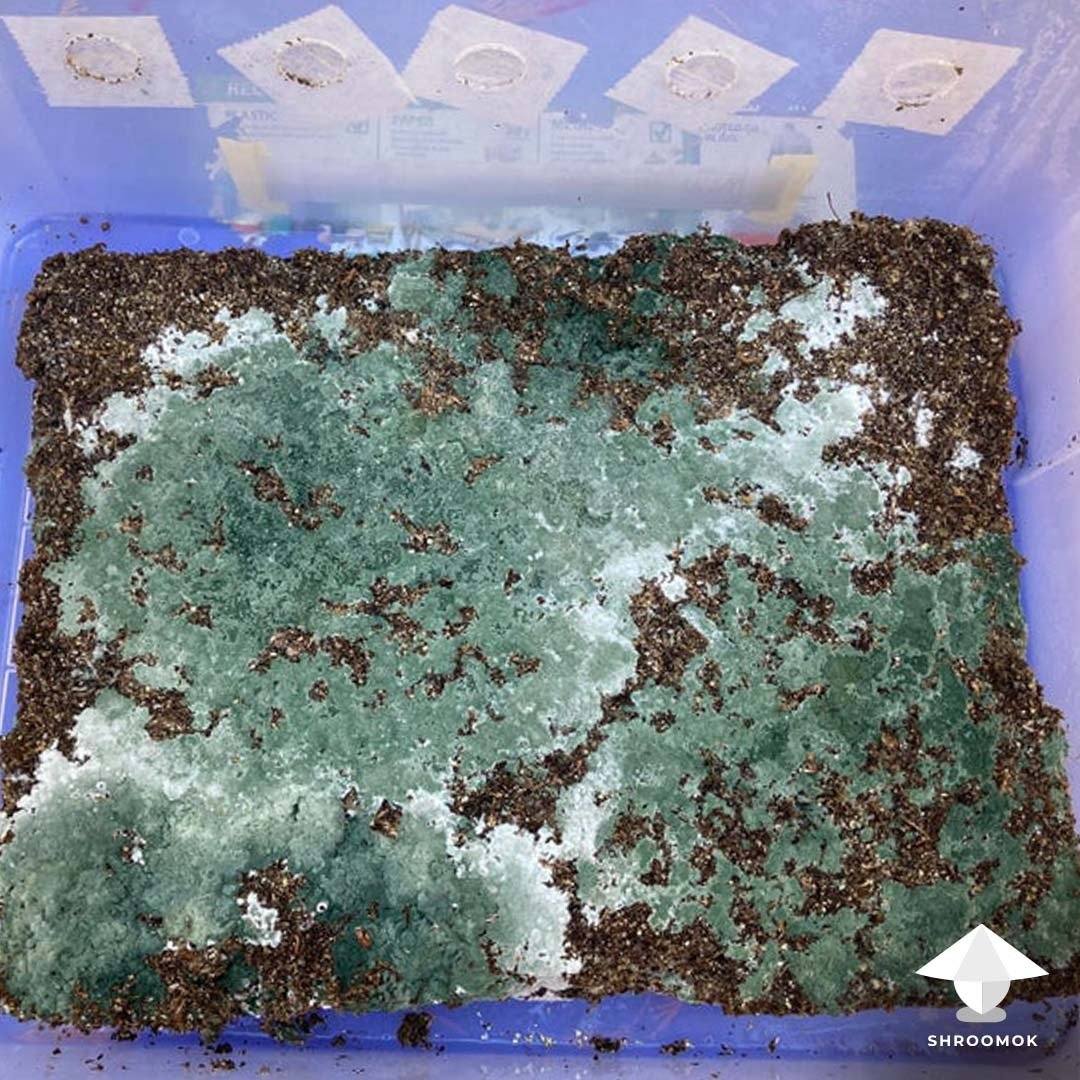


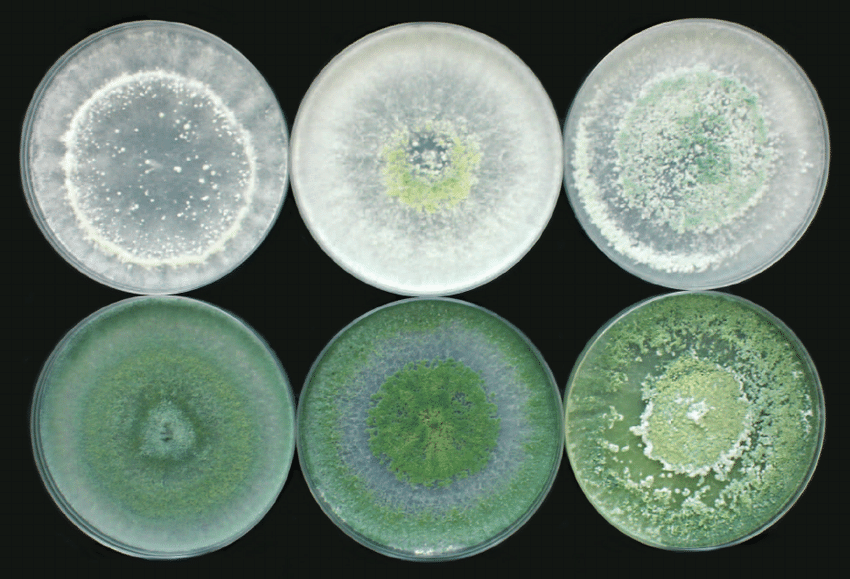
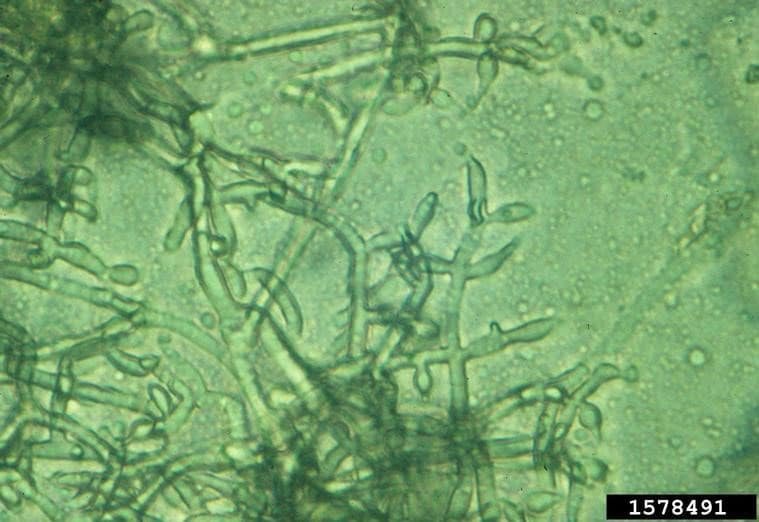
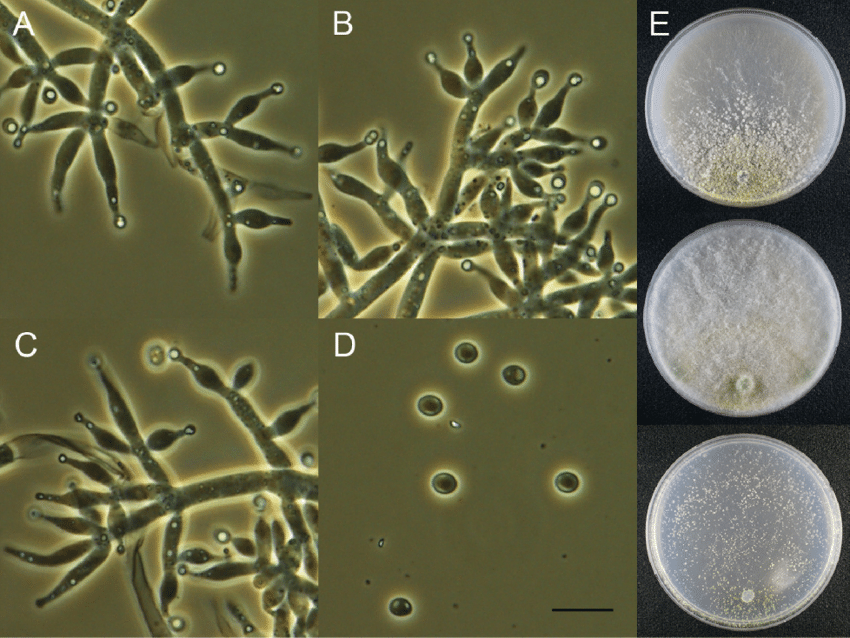
Trichoderma or Green Mold is a soil dwelling fungi found all over the world that causes problems in sterile mushroom farms. If a mushroom block has green mold growing on it, it’s not a loss. It actually benefits plants in the following ways:
Root Development: Trichoderma produces growth-promoting hormones like indole acetic acid (IAA), which stimulate root growth, leading to a more extensive and healthy root system. This allows trees to access more water and nutrients.
Enhanced Nutrient Uptake: Trichoderma forms a symbiotic relationship with tree roots, enhancing the absorption of nutrients, especially nitrogen, phosphorus, and essential micronutrients. This promotes better tree growth and vigor.
Disease Suppression: Trichoderma helps trees fight off pathogens by parasitizing harmful fungi and secreting enzymes that break down pathogen cell walls. This protects the tree from diseases, allowing it to grow without stress.
Stress Resistance: It boosts the tree's ability to withstand abiotic stresses like drought and salinity by producing compounds that enhance the plant’s stress tolerance mechanisms.
Soil Health: Trichoderma improves soil structure and fertility by breaking down organic matter and promoting microbial diversity, creating a better growing environment for trees.
Source: https://doi.org/10.1016/B978-0-12-822919-4.00003-X
Wear a mask when composting blocks with green mold. Breathing a lot of spores can cause respiratory issues.

September Mushroom of the Month: 𝘗𝘪𝘴𝘰𝘭𝘪𝘵𝘩𝘶𝘴 𝘢𝘳𝘩𝘪𝘻𝘶𝘴
The Mushroom of the Month for September is the, 𝘗𝘪𝘴𝘰𝘭𝘪𝘵𝘩𝘶𝘴 𝘢𝘳𝘩𝘪𝘻𝘶𝘴


🌈🐶💩The September mushroom of the month is the 𝘗𝘪𝘴𝘰𝘭𝘪𝘵𝘩𝘶𝘴 𝘢𝘳𝘩𝘪𝘻𝘶𝘴, colloquial names - Dead Man’s Foot, Bohemian truffle and Dog Turd Fungus, used for dyeing fabric and is also a mycorrhizal inoculate and helps plants establish roots. Swipe to learn more about this fascinating mushroom.
🙌 to @chaoticmessy for naming that mushroom correctly and becoming the 1,301th member of Central Texas Mycology!
Become a supporting member to stay dialed-in with events & discover next month’s mystery mushroom.
What is that thing?
Many people find themselves asking this question when coming across Pisolithus in the wild, which has led to it being called by many interesting colloquial names - Dead Man’s Foot, Bohemian truffle and Dog Turd Fungus, to name a few. It is a prolific species that occurs worldwide, sometimes growing by itself and other times mycorrhizal with pine, oaks and cedars. The fruiting body is 5–30 cm tall and 4–20 cm wide, with a thin yellow-brown to brown exterior layer and the spores are brown.
natural colors with Pisolithus
The common name of Dyeball refers to the traditional use of this fungus as a natural dye for textiles. Pisolithus starts out as a club-shaped dark brown object, that when cut open shows those ‘peas’ — little compartments in which the spores are formed, resembling what has been described as ‘rice crispies in tar’. In this stage, the mushroom is firm, wet, and will stains whatever it touches. In the next phase the top matures, the outer wall disintegrates and a dark chocolate brown dry spore mass is visible. The spores have pigmented hydrophobic walls, making them effective for long distance travel and also a powerful coloring agent.
is it edible?
While the Dyeball is not an edible mushroom for humans, it is highly nutritious for plants, especially trees! Because it forms mycorrhizas with almost any kind of root, this ectomycorrhizal fungus is frequently used by foresters (and in recent years by gardeners, too) as the basis of a soil inoculant to promote tree and plant growth - particularly in remediation of areas of degraded or polluted land or formerly clear-felled forest sites.