
August Mushroom of the Month: Flower Pot Parasol
The Mushroom of the Month for August is the Flower Pot Parasol, Leucocoprinus birnbaumii


🔥The August mushroom of the month is the Leucocoprinus birnbaumii, commonly known as the Flower Pot Parasol, a saprophytic fungi native to the tropics. In recent times it has become common in greenhouses and indoor plants in temperate regions, its spores having hitched rides in the tropical plant trade.
🙌 to Aerie for naming that mushroom correctly and becoming the newest member of Central Texas Mycology!
Why the name?
The Flower Pot Parasol, aka yellow parasol, flowerpot parasol, or plantpot dapperling, is a species of gilled mushroom in the family Agaricaceae. It is common in the tropics and subtropics but in temperate regions it frequently occurs in greenhouses and flowerpots, hence its common names.
how did it get into my flower pot?
The Flower Pot Parasol was first described in 1788 by English mycologist James Bolton who described an observation from a hothouse near Halifax, three years earlier in 1785. During this era, exotic plants from tropical areas were being brought to and cultivated in greenhouses and gardens from the East Indies and India, so it is likely the spores hitched a ride in the soil or mulch.
is it edible?
Although the Flower Pot Parasol does look beautiful it is not edible. Though it will not kill you, it will cause some very unpleasant gastrointestinal irritation. However, it may have medicinal uses. A 2015 study showed that fatty acids extracted from Leucocoprinus birnbaumii have moderate but selective anti-microbial effects.
BECOME A SUPPORTING MEMBER & stay Dialed in with events & discover next month’s mystery mushroom

July Mushroom of the Month: Southern Clam Shell, Fomes fasciatus
The July mushroom of the month is the 𝘍𝘰𝘮𝘦𝘴 𝘧𝘢𝘴𝘤𝘪𝘢𝘵𝘶𝘴


🔥The July mushroom of the month is the 𝘍𝘰𝘮𝘦𝘴 𝘧𝘢𝘴𝘤𝘪𝘢𝘵𝘶𝘴, commonly known as the Southern Clam Shell, a white rot fungi that grows in the Southeastern parts of North America and is a tinder conch and can be used to start fire.
🙌 to Eldon for naming that mushroom correctly and becoming the newest member of Central Texas Mycology!
WHAT IS IT?
The Southern Clam Shell, Fomes fasciatus, is a pathogenic white rot polypore fungus that grows on hardwood trees in southeastern North America, South and Central America. It has also been documented in Australia and Asia. It has a hard outer shell shaped like a clam or hoof, earning it the nickname ‘horse hoof’ fungus.
Traditional uses
The Southern Clam Shell has an interior trauma layer that can be harvested for tinder. The material, called Amadou, has been coveted since ancient times for its ability to start fires quickly even in inclement condi-tions. Otzi, the famous 5,300 year old mummy found frozen in the alps, was carrying Fomes fomentarius, the northern relative of the Southern Clam Shell, when he died.
FUTURE USES
Fomes fasciatus has also been researched as a potential cheap biosorbent of heavy metals due to its common occurrence and lack of current economic use. The research evaluated the dried and pulverized fruiting bodies ability to absorb Cu II (copper compounds) commonly found in wastewater and found that treating the prepared fungi with hot-alkali improved its sorbent properties.
BECOME A SUPPORTING MEMBER & stay Dialed in with events & discover next month’s mystery mushroom

June Mushroom of the Month: Ganoderma sessile
The June mushroom of the month is Ganoderma sessile or Reishi!
What is It?


Ganoderma sessile is a recently re-named species of Reishi found in north America. Previously it was known as Ganoderma lucidum, the species commonly referred to as Reishi found in Asia and Europe. However, recent genealogical evidence has indicated that the north American variety is a unique species.
WHAT CHANGED?
For many years, Ganoderma sessile was considered to be Ganoderma lucidum. Research published in 2018 by Loyd et al found that Ganoderma lucidum was in fact only native to two places in North America, Utah and northern Califorina, and is likely a non-native species introducted accidently by cultivators. Ganoderma sessile is a related species native to North America.
IS ALL REISHI THE SAME?
Species of Ganoderma, commonly called reishi (in Japan) or lingzhi (in China), have been used in traditional medicine for thousands of years. Research by Loyd et al has shown that products labeled as ‘reishi’ often contain a mix of species from this genus, including G. applanatum, G. australe, G. gibbosum, G. sessile, and G. sinense. There is likely differences between the species in terms of potency but more research is needed.
BECOME A SUPPORTING MEMBER & stay Dialed in with events & discover next month’s mystery mushroom

8 Ways to Learn to Identify & Forage Wild Mushrooms
We are in peak foraging season with the recent rain. We have several resources we recommend you check out.
We are in peak foraging season with the RECENT rain. We have several resources we recommend you check out.

🌐 Visit our website and take the online foraging mushrooms class. It comes with a foraging calendar download.
📝 Visit our blog for the latest foraging forecasts and tips on how to take photos of mushrooms for positive identification.
🥾 Check our calendar for upcoming mushroom walks we have a 🔦UV night walk coming up soon.
🔪 Check out the latest issue of Texas Monthly to learn about foraging wood blewits
🧺 The Texas Parks & Wildlife Magazine also has lots of great article in their March issue on foraging mushrooms.
♉ Join us at Texas Mushroom Conference late this month, forage.atx will be keynoting on Foraging Mushrooms in Texas.
🏷️ Tag us to get help with ID and add your observations to iNaturalist.org. If you are trying a new mushroom, confirm the ID with a human expert. Always cook, then try a small amount to make sure you don't have a reaction.
📋 Become a member and learn more about wild mushroom foraging in Texas! Membership benefits include early access and discounts to walks, workshops, and more. Your membership helps support the larger community!

May Mushroom of the Month: Favolus or Honeycomb Fungus
The May mushroom of the month is the tropical and edible Favolus species
What is It?
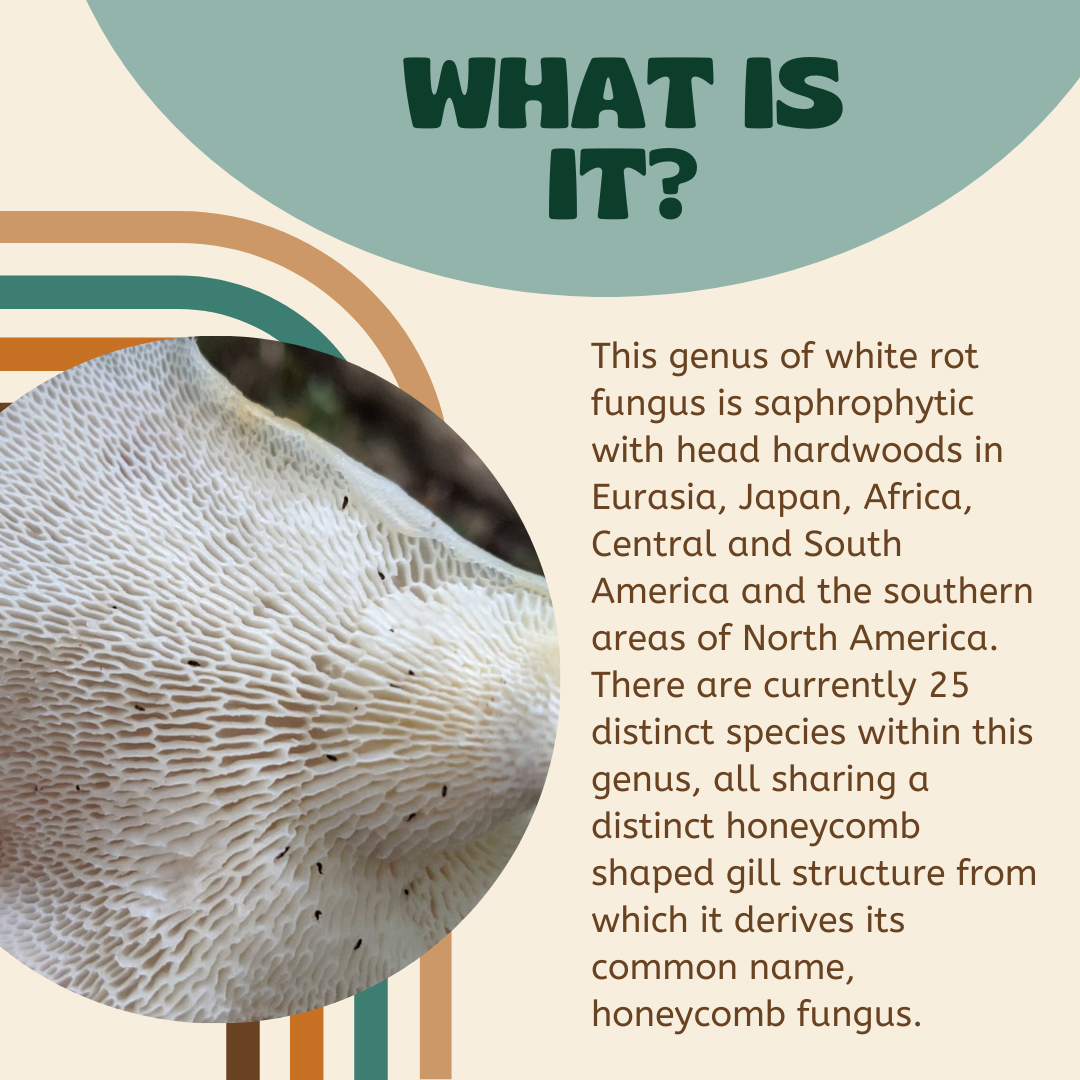


This genus of white rot fungus is saphrophytic with head hardwoods in Eurasia, Japan, Africa, Central and South America and the southern areas of North America. There are currently 25 distinct species within this genus, all sharing a distinct honeycomb shaped gill structure from which it derives its common name, honeycomb fungus.
Is it edible?
Honeycomb fungus is not considered a choice edible mostly because of the texture. However, in 2020 a paper was published on the commercial cultivation, nutrition and food potential of this tropical mushroom in the Amazon where it is native and collected by the Yanomami people, who already sell more than 10 Amazon mushroom species. You can learn more about their mushroom culture in this film by @beatrizmaues.
Foraging Tips
Look for honeycomb fungus on the trunks and base of dead and rotting hardwoods, such as oak and pecan in central and east Texas.The best time to harvest is when the fungus is soft and fresh, before they have begun to harden and turn yellow. Check this months foraging forecast on our blog for more tips on cooking with this shroom from @forage.atx!