
September Foraging Forecast
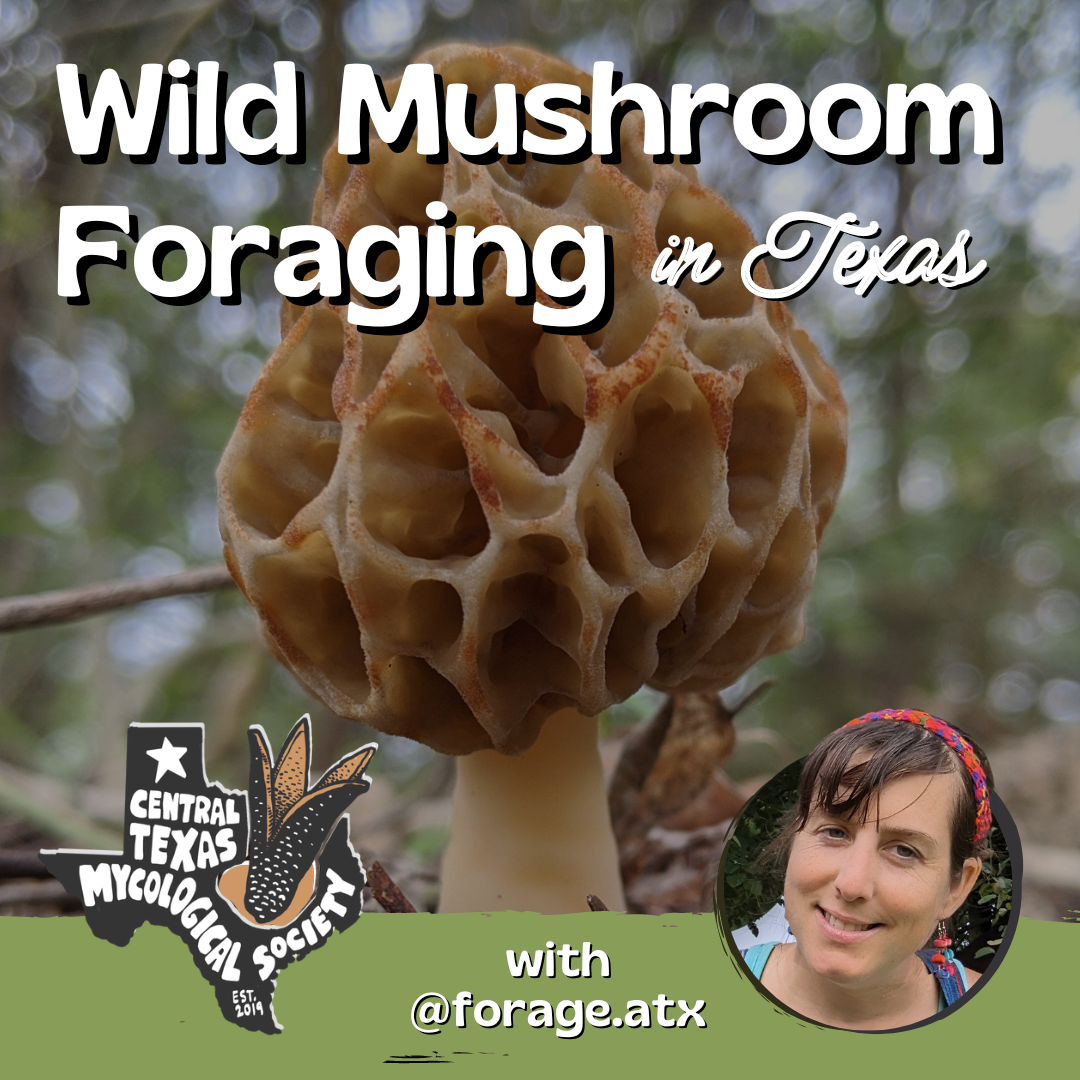
Learn wild, edible mushrooms fruiting in Texas after rain.
Learn wild, edible mushrooms fruiting in Texas after rain.
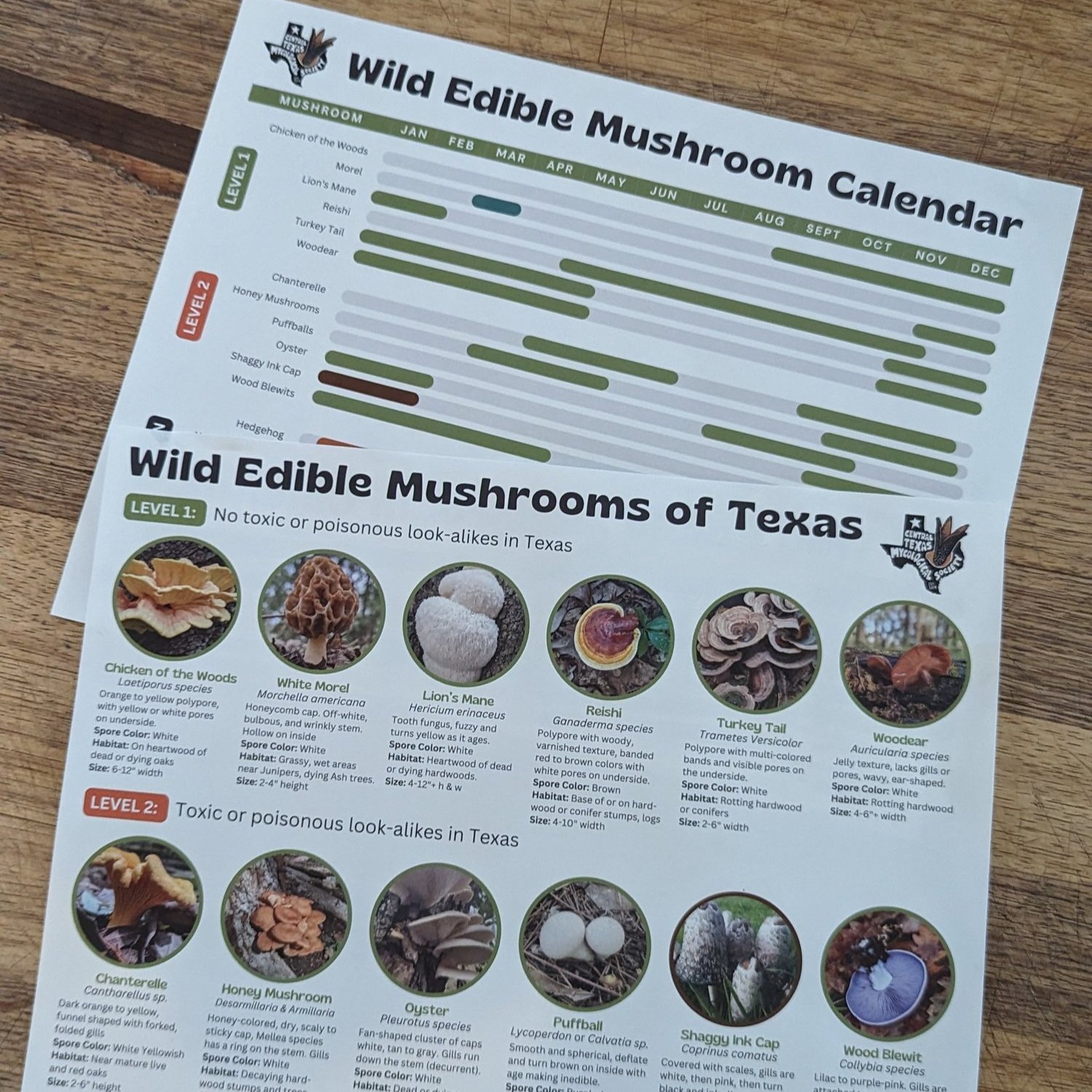
Comes with download of a Wild Edible Mushroom Calendar.

Huitlacoche: Mycosarcoma maydis
DESCRIPTION: Called “corn smut” and considered a pathogen by most U.S. farmers. In Latin America it is a delicacy, rooted in indigenous cultures who intentionally grow the fungus as a complete source of nutrition.
Habitat: Heirloom Corn
Spore Color: Black
Size: ½ to 11 inches, kernels to swell up to 10 times their normal size
Edibility: Delicate, earthy flavor that compares to truffles.
Look-alikes: None
Learn about our Huitlacoche Growing Experiment.

Chicken of the Woods: Laetiporus, 4 species in texas
DESCRIPTION: Orange to yellow polypore, with yellow or white pores on underside.
Habitat: Grows in shelfs on heartwood of dead or dying oaks.
Spore Color: White Size: 6-12" width
Edibility: Contains proteins, fat, fiber and tastes just like chicken! Harvest when young, colorful, and moist. Becomes lighter in color, fiborus, mealy and dry, inedible with age.
Look-alikes: Shaggy Bracket, Inonotus hispidus (non-toxic)

REISHI: Ganoderma, 12 species in Texas
DESCRIPTION: Polypore with woody, varnished texture, banded red to brown colors with white pores on underside.
HABITAT: Grows at base or on hardwood stumps, logs, especially oaks and pecan. Pines in East Texas.
SPORE COLOR: Brown
SIZE: 4-10" width
EDIBILITY: Medicinal. Very bitter because of medicinal compounds.
LOOK-ALIKES: Red-Belted Conk, Fomitosis Pinicola (also medicinal).

Honeycomb Fungus: Favolus 3 species in Texas
DESCRIPTION: Genus of tropical fungi in the family Polyporaceae but with fleshy with radially arranged pores on the underside of the cap that are angular and deeply pitted, somewhat resembling a honeycomb. White to yellow and grows alone or in overlapping clusters similar to oyster mushrooms or other shelf fungi.
HABITAT: On decaying hard-wood, year round when humidity is high after rain.
SPORE COLOR: White
SIZE: 3-6" wide
EDIBILITY: Odor slightly foul, especially in rehydrated material; taste not distinctive. Tough texture and can be cooked like chicharrones.
LOOK A-LIKE: Oysters, Pluerotus or Lentinellus cochleatus (none observed in Texas) but grow on decomposing wood.

Wood Ear: Auricularia 6+- species in Texas
DESCRIPTION: Brown to amber in color. Jelly texture that is irregular, wavy, and ear-shaped. Lacks gills or pores.
HABITAT: Grows in clusters on decaying hardwood after rain
SPORE COLOR: White
SIZE: 4-6" in width and > 1/4" thick
EDIBILITY: Wood ear mushrooms are a popular ingredient in many Chinese dishes, such as hot and sour soup, and also used in Chinese medicine. It is also used in Ghana, as a blood tonic. Modern research into possible medical applications has variously concluded that wood ear has anti-tumor, hypoglycemic, anticoagulant and cholesterol-lowering properties.
LOOK-ALIKES: Amber Jelly, Exidia recisa which is also edible.

Puffball: Lycoperdon and Calvatia, 15+- species in Texas
DESCRIPTION: Smooth and spherical, deflate and turn purplish or brown on inside with age making inedible. Some peal and have spines.
HABITAT: Overgrazed Prairie or grasslands.
SPORE COLOR: Purple-brown
SIZE: 2- 60" diameter
EDIBILITY: Doesn’t have a strong flavor of its own and absorb flavors. Try making a Giant Puffball Pizza.
LOOK-ALIKES: Amanita species which can contain toxins and be fatal. If center of puffball is not white, it can cause GI distress.

Blue Milkcap: Lactarius Indigo
DESCRIPTION: Blue cap with concentric rings and a depression in center, sticky or slimy to the touch. Brittle flesh, stem. Gills and body exude blue latex when injured tissue is and stains the wounded tissue greenish blue.
HABITAT: Mycorrhizal and grows in deciduous and coniferous forests.
SPORE COLOR: Cream
SIZE: 2.0–5.9" cap width
EDIBILITY: Choice. Peppery taste and has a coarse, grainy texture.
LOOK-ALIKES: Blewit, Collybia nuda or Lactarius paradoxus (edible)

Chanterelles: Cantharellus, 10+- species in Texas
DESCRIPTION: Red, orange, yellow to white, meaty and funnel-shaped and can be found in clusters or individual mushrooms. On the lower surface, underneath the smooth cap, most species have rounded, forked folds that run almost all the way down the stipe, which tapers down seamlessly from the cap.
HABITAT: Symbiotic and found around 5-30 feet of mature live and red oaks after a lot of rain. Chanterelles need a lot of rain to fruit and they like the torrential Texas-style flash floods. Trees near creeks and where water is flowing downhill is very important. Avoid trees that are in areas that are mowed. Trees with undisturbed leaf matter and not many understory plants are ideal.
SPORE COLOR: White Yellowish
SIZE: 2-6" height
EDIBILITY: Choice. Many species emit a fruity aroma, reminiscent of apricots, and often have a mildly peppery taste.
LOOK A-LIKE: The Southern Jack-o-lantern, Omphalotus subilludens is the toxic look-a-like and is orange to brown in color. They do grow at the same time but their habitat and morphology is different.

Oyster: Pleurotus ostreatus
DESCRIPTION: Color can vary white, tan and gray.White to cream gills, run down stem.
HABITAT: Grows in clusters and decomposes hardwood.
SPORE COLOR: White
SIZE: Cap fan shaped, 2"-8" across.
EDIBILITY: Choice. Delicious meat replacement in all types of cuisines
LOOK A-LIKE: The Southern Jack-o-lantern, Omphalotus subilludens is the toxic look-a-like and is orange to brown in color. They do grow at the same time but their habitat and morphology is different.

Turkey Tail: Trametes versicolor
DESCRIPTION: Variable coloration, distinct striping pattern. No gills, pores are small and round, white to light brown
HABITAT: Grows in overlapping clusters on logs and stumps
SPORE COLOR: White
SIZE: Cap fan shaped, 2"-8" across.
EDIBILITY: Medicinal. Tough, leathery flesh. Can be brewed into a tea, broth, or extracted into a tincture.
LOOK A-LIKE: False turkey tail. or Stereum ostrea and is non-toxic. Mushroom Expert has a useful check list to determine if it is true medicinal turkey tail.
Become a member and learn more about wild mushroom foraging in Texas!
Membership benefits include early access and discounts to walks, workshops, and more. Your membership helps support the larger community! Tag us to get help with ID and add your observations to iNaturalist.org. If you are trying a new mushroom, confirm the ID with an expert, then try a small amount to make sure you don't have an allergic reaction. Texas Mushroom Identification Facebook group is great for quick responses and ID help. Also, don't forget to add your finds on the Mushrooms of Texas project on iNaturalist.
Follow my adventures @forage.atx.

August Mushroom of the Month: Blushing Rosette, Abortiporus biennis
The August Mushroom of the Month is the The Blushing Rosette, Abortiporus biennis


🍄⭐The August mushroom of the month is the Blushing Rosette, Abortiporus biennis
👏 Congrats to Sophia for guessing it right and winning a membership to the society! 🎉
You can also be a supporting member to stay dialed-in with events & discover next month’s mystery mushroom.
Blushing Rosette
Abortiporus biennis — the blushing rosette - is a rare but charismatic bracket fungus that has a soft spot for our local oak and elm trees. Around East and Central Texas, you might spot it fruiting in spring or fall, usually on dead or dying branches. Its brackets are semicircular to kidney-shaped, with a smooth, velvety top and a pore surface that glows white to cream.
Two distinct forms of Abortiporus biennis can be encountered: a "normal" looking, regular sort of polypore with a brown cap and a whitish pore surface that bruises reddish to reddish brown—and a gnarled, messy-looking, "aborted" form that consists of a mass of irregular white pores that exude a reddish juice and bruise reddish brown; in this form there is hardly a cap or a stem to speak of, and as the mushroom grows it often engulfs sticks and blades of grass.
A Tricky Taxonomy
Taxonomists have had quite the time with Abortiporus. There are at least 55 different names it’s gone by — a mix of species and genus labels — thanks to its wildly different forms. They can look so unlike each other (and unlike other polypores) that early mycologists kept thinking they’d discovered something new. To make matters even more interesting, Abortiporus biennis produces both sexual spores and asexual chlamydospores, which led to its anamorphic forms getting their own separate names.
Why We Love It: This is a fungus with a serious flair for disguise. It’s a living example of why mushroom ID can be equal parts science, art, and wild goose chase — and we’re here for it.
Tips for ID
Cap: 5–15 cm across; roundish-to semicircular, kidney-shaped, or irregular in outline; planoconvex; finely to thickly velvety, or sometimes more or less bald; dry; light brown to reddish brown or tan, with a pale margin; sometimes with concentric zones of brown shades.
Pore Surface: Whitish, bruising and discoloring reddish or pinkish brown; pores appearing "stuffed" when young, later angular to maze-like or irregular, 1–4 per mm; tubes to 5 mm deep.
Stem: When present 3–10 cm long; 1–3 cm thick; lateral; tapering to base; soft and spongy; fuzzy; brownish.
Flesh: White to pinkish or pale tan; exuding a pinkish juice when squeezed; tough.
Odor: Fragrant or, often, somewhat foul.
Chemical Reactions: KOH on flesh negative to pale brown.
Spore Print: White.
Become a Supporting Member and stay dialed in with events & discover next month’s mystery mushroom.

August Foraging Forecast
Learn wild, edible mushrooms fruiting in Texas after rain.
Learn wild, edible mushrooms fruiting in Texas after rain.
Comes with download of a Wild Edible Mushroom Calendar.

Chicken of the Woods: Laetiporus, 4 species in texas
Orange to yellow polypore, with yellow or white pores on underside.
Habitat: Grows in shelfs on heartwood of dead or dying oaks.
Spore Color: White Size: 6-12" width
Edibility: Contains proteins, fat, fiber and tastes just like chicken! Harvest when young, colorful, and moist. Becomes lighter in color, fiborus, mealy and dry, inedible with age.
Look-alikes: Shaggy Bracket, Inonotus hispidus (non-toxic)

Huitlacoche: Mycosarcoma maydis
Called “corn smut” and considered a pathogen by most U.S. farmers. In Latin America it is a delicacy, rooted in indigenous cultures who intentionally grow the fungus as a complete source of nutrition.
Habitat: Heirloom Corn
Spore Color: Black
Size: ½ to 11 inches, kernels to swell up to 10 times their normal size
Edibility: Delicate, earthy flavor that compares to truffles.
Look-alikes: None
Learn About Our Huitlacoche Growing Experiment!

Reishi: Ganoderma, 12 species in Texas
Polypore with woody, varnished texture, banded red to brown colors with white pores on underside.
HABITAT: Grows at base or on hardwood stumps, logs, especially oaks and pecan. Pines in East Texas.
SPORE COLOR: Brown
SIZE: 4-10" width
EDIBILITY: Medicinal. Very bitter because of medicinal compounds.
LOOK-ALIKES: Red-Belted Conk, Fomitosis Pinicola (also medicinal).

Honeycomb Fungus: Favolus 3 species in Texas
Genus of tropical fungi in the family Polyporaceae but with fleshy with radially arranged pores on the underside of the cap that are angular and deeply pitted, somewhat resembling a honeycomb. White to yellow and grows alone or in overlapping clusters similar to oyster mushrooms or other shelf fungi.
HABITAT: On decaying hard-wood, year round when humidity is high after rain.
SPORE COLOR: White
SIZE: 3-6" wide
EDIBILITY: Odor slightly foul, especially in rehydrated material; taste not distinctive. Tough texture and can be cooked like chicharrones.
LOOK A-LIKE: Oysters, Pluerotus or Lentinellus cochleatus (none observed in Texas) but grow on decomposing wood.

WOOD EAR: Auricularia 6+- species in Texas
Brown to amber in color. Jelly texture that is irregular, wavy, and ear-shaped. Lacks gills or pores.
HABITAT: Grows in clusters on decaying hardwood after rain
SPORE COLOR: White
SIZE: 4-6" in width and > 1/4" thick
EDIBILITY: Wood ear mushrooms are a popular ingredient in many Chinese dishes, such as hot and sour soup, and also used in Chinese medicine. It is also used in Ghana, as a blood tonic. Modern research into possible medical applications has variously concluded that wood ear has anti-tumor, hypoglycemic, anticoagulant and cholesterol-lowering properties.
LOOK-ALIKES: Amber Jelly, Exidia recisa which is also edible.

Puffball: Lycoperdon and Calvatia, 15+- species in Texas
Smooth and spherical, deflate and turn purplish or brown on inside with age making inedible. Some peal and have spines.
HABITAT: Overgrazed Prairie or grasslands.
SPORE COLOR: Purple-brown
SIZE: 2- 60" diameter
EDIBILITY: Doesn’t have a strong flavor of its own and absorb flavors. Try making a Giant Puffball Pizza.
LOOK-ALIKES: Amanita species which can contain toxins and be fatal. If center of puffball is not white, it can cause GI distress.

Blue Milkcap: Lactarius Indigo
Blue cap with concentric rings and a depression in center, sticky or slimy to the touch. Brittle flesh, stem. Gills and body exude blue latex when injured tissue is and stains the wounded tissue greenish blue.
HABITAT: Mycorrhizal and grows in deciduous and coniferous forests.
SPORE COLOR: Cream
SIZE: 2.0–5.9" cap width
EDIBILITY: Choice. Peppery taste and has a coarse, grainy texture.
LOOK-ALIKES: Blewit, Collybia nuda or Lactarius paradoxus (edible)

Chanterelle: Cantharellus, 10+- species in Texas
DESCRIPTION: Red, orange, yellow to white, meaty and funnel-shaped and can be found in clusters or individual mushrooms. On the lower surface, underneath the smooth cap, most species have rounded, forked folds that run almost all the way down the stipe, which tapers down seamlessly from the cap.
SPORE COLOR: White Yellowish
HABITAT: Symbiotic and found around 5-30 feet of mature live and red oaks after a lot of rain. Chanterelles need a lot of rain to fruit and they like the torrential Texas-style flash floods. Trees near creeks and where water is flowing downhill is very important. Avoid trees that are in areas that are mowed. Trees with undisturbed leaf matter and not many understory plants are ideal.
SIZE: 2-6" height
EDIBILITY: Choice. Many species emit a fruity aroma, reminiscent of apricots, and often have a mildly peppery taste.
LOOK A-LIKE: The Southern Jack-o-lantern, Omphalotus subilludens is the toxic look-a-like and is orange to brown in color. They do grow at the same time but their habitat and morphology is different.

Lobster mushroom, Hypomyces lactifluorum
Parasitic fungus that grows on certain species of mushrooms, turning them a reddish orange color that resembles the outer shell of a cooked lobster.
HABITAT: Grows in mixed woods where H. lactifluorum specifically attacks members of the genera Lactarius and Lactifluus (milk-caps), and Russula (brittlegills), such as Russula brevipes and Lactifluus piperatus in North America. At maturity, H. lactifluorum thoroughly covers its host, rendering it unidentifiable.
SPORE PRINT: White spore print
Edible with a subtle shellfish flavor that's easy to identify with no look alikes.
LOOK A-LIKE: The Southern Jack-o-lantern, Omphalotus subilludens is the toxic look-a-like and is orange to brown in color. They do grow at the same time but their habitat and morphology is different.
NOTE: I spotted this Lobster after we had torrential rain in 2019. Hypomyces may be parasitizing these mushrooms. Several members of the community have already seen them this year!
Become a member and learn more about wild mushroom foraging in Texas!
Membership benefits include early access and discounts to walks, workshops, and more. Your membership helps support the larger community! Tag us to get help with ID and add your observations to iNaturalist.org. If you are trying a new mushroom, confirm the ID with an expert, then try a small amount to make sure you don't have an allergic reaction. Texas Mushroom Identification Facebook group is great for quick responses and ID help. Also, don't forget to add your finds on the Mushrooms of Texas project on iNaturalist.
Follow my adventures @forage.atx.

July Mushroom of the Month: Purple-spored Puffball, Calvatia cyathiformis
The July Mushroom of the Month is the Purple-spored puffball, Calvatia cyathiformis
🍄⭐The July mushroom of the month is Purple-spored Puffball, Calvatia cyathiformis
👏 Congrats to May Feng for guessing it right and winning a membership to the society! 🎉
You can also be a supporting member to stay dialed-in with events & discover next month’s mystery mushroom.
puffball gigante
Two grapefruit-sized puffballs bloom in the grasslands of North America: the Giant Puffball, Calvatia gigantea, and the Purple-spored Puffball, Calvatia cyathiformis. Both are edible when young—their interiors pure white and marshmallow-soft. What distinguishes the Purple-spored from its cousin is its transformation with age—body and spores evolving from pure white to deep, rich purple. In East and Central Texas, it fruits June to October, often in open woods, fields, and roadsides. The fungus grows in various soils, including clay, loam, and sand, and is associated with oak, pine, and other deciduous trees
taxonomy & ecology
Calvatia cyathiformis, or purple-spored puffball, is a large saprobic Calvatia species. This terrestrial puffball has purplish to purple-brown spores, distinguishing it from other large Agaricales. The fruiting body is 5–20 cm (2–8 in) high or broad. When young it’s smooth, spherical or slightly flattened, and white, purplish, or brownish. It has a chocolate-brown or purple gleba with a smooth exoperidium. As it matures, it becomes pear- or top-shaped, and the exterior darkens or silvers. Later, the skin cracks, releasing spores dispersed by wind and rain. A leathery sterile cup remains after spores disperse.
uses & benefits
Besides being edible when young, puffballs can be used to dye fabrics and paper when used in combination with ammonia (as a mordant). Purple-spored Puffballs create a rusty red color while Giant Puffballs make a more reddish-brown dye. Medical scientists are currently investigating puffballs in the genus Calvatia because they have been shown to prevent some types of tumors. For years, puffballs have been used as a styptic to stop bleeding and to dress wounds − both powdered and slices of the mushroom.
BECOME A SUPPORTING MEMBER & stay Dialed in with events & discover next month’s mystery mushroom


July Foraging Forecast
Learn wild, edible mushrooms fruiting in Texas after rain.
Learn wild, edible mushrooms fruiting in Texas after rain.
Comes with download of a Wild Edible Mushroom Calendar.
REISHI: Ganoderma, 12 species in Texas
Polypore with woody, varnished texture, banded red to brown colors with white pores on underside.
HABITAT: Grows at base or on hardwood stumps, logs, especially oaks and pecan. Pines in East Texas.
SPORE COLOR: Brown
SIZE: 4-10" width
EDIBILITY: Medicinal. Very bitter because of medicinal compounds.
LOOK-ALIKES: Red-Belted Conk, Fomitosis Pinicola (also medicinal).
honeycomb fungus: FavoluS 3 species in Texas
Genus of tropical fungi in the family Polyporaceae but with fleshy with radially arranged pores on the underside of the cap that are angular and deeply pitted, somewhat resembling a honeycomb. White to yellow and grows alone or in overlapping clusters similar to oyster mushrooms or other shelf fungi.
HABITAT: On decaying hard-wood, year round when humidity is high after rain.
SPORE COLOR: White
SIZE: 3-6" wide
EDIBILITY: Odor slightly foul, especially in rehydrated material; taste not distinctive. Tough texture and can be cooked like chicharrones.
LOOK A-LIKE: Oysters, Pluerotus or Lentinellus cochleatus (none observed in Texas) but grow on decomposing wood.
WOOD EAR: Auricularia 6+- species in Texas
Brown to amber in color. Jelly texture that is irregular, wavy, and ear-shaped. Lacks gills or pores.
HABITAT: Grows in clusters on decaying hardwood after rain
SPORE COLOR: White
SIZE: 4-6" in width and > 1/4" thick
EDIBILITY: Wood ear mushrooms are a popular ingredient in many Chinese dishes, such as hot and sour soup, and also used in Chinese medicine. It is also used in Ghana, as a blood tonic. Modern research into possible medical applications has variously concluded that wood ear has anti-tumor, hypoglycemic, anticoagulant and cholesterol-lowering properties.
LOOK-ALIKES: Amber Jelly, Exidia recisa which is also edible.
Puffball: Lycoperdon and Calvatia, 15+- species in Texas
Smooth and spherical, deflate and turn purplish or brown on inside with age making inedible. Some peal and have spines.
HABITAT: Overgrazed Prairie or grasslands.
SPORE COLOR: Purple-brown
SIZE: 2- 60" diameter
EDIBILITY: Doesn’t have a strong flavor of its own and absorb flavors. Try making a Giant Puffball Pizza.
LOOK-ALIKES: Amanita species which can contain toxins and be fatal. If center of puffball is not white, it can cause GI distress.
Blue Milkcap: Lactarius Indigo
Blue cap with concentric rings and a depression in center, sticky or slimy to the touch. Brittle flesh, stem. Gills and body exude blue latex when injured tissue is and stains the wounded tissue greenish blue.
HABITAT: Mycorrhizal and grows in deciduous and coniferous forests.
SPORE COLOR: Cream
SIZE: 2.0–5.9" cap width
EDIBILITY: Choice. Peppery taste and has a coarse, grainy texture.
LOOK-ALIKES: Blewit, Collybia nuda or Lactarius paradoxus (edible)
CHANTERELLE: Cantharellus, 10+- species in Texas
DESCRIPTION: Red, orange, yellow to white, meaty and funnel-shaped and can be found in clusters or individual mushrooms. On the lower surface, underneath the smooth cap, most species have rounded, forked folds that run almost all the way down the stipe, which tapers down seamlessly from the cap.
SPORE COLOR: White Yellowish
HABITAT: Symbiotic and found around 5-30 feet of mature live and red oaks after a lot of rain. Chanterelles need a lot of rain to fruit and they like the torrential Texas-style flash floods. Trees near creeks and where water is flowing downhill is very important. Avoid trees that are in areas that are mowed. Trees with undisturbed leaf matter and not many understory plants are ideal.
SIZE: 2-6" height
EDIBILITY: Choice. Many species emit a fruity aroma, reminiscent of apricots, and often have a mildly peppery taste.
LOOK A-LIKE: The Southern Jack-o-lantern, Omphalotus subilludens is the toxic look-a-like and is orange to brown in color. They do grow at the same time but their habitat and morphology is different.
Lobster mushroom, Hypomyces lactifluorum
Parasitic fungus that grows on certain species of mushrooms, turning them a reddish orange color that resembles the outer shell of a cooked lobster.
HABITAT: Grows in mixed woods where H. lactifluorum specifically attacks members of the genera Lactarius and Lactifluus (milk-caps), and Russula (brittlegills), such as Russula brevipes and Lactifluus piperatus in North America. At maturity, H. lactifluorum thoroughly covers its host, rendering it unidentifiable.
SPORE PRINT: White spore print
Edible with a subtle shellfish flavor that's easy to identify with no look alikes.
LOOK A-LIKE: The Southern Jack-o-lantern, Omphalotus subilludens is the toxic look-a-like and is orange to brown in color. They do grow at the same time but their habitat and morphology is different.
NOTE: I spotted this Lobster after we had torrential rain in 2019. Hypomyces may be parasitizing these mushrooms. Several members of the community have already seen them this year!
Become a member and learn more about wild mushroom foraging in Texas!
Membership benefits include early access and discounts to walks, workshops, and more. Your membership helps support the larger community! Tag us to get help with ID and add your observations to iNaturalist.org. If you are trying a new mushroom, confirm the ID with an expert, then try a small amount to make sure you don't have an allergic reaction. Texas Mushroom Identification Facebook group is great for quick responses and ID help. Also, don't forget to add your finds on the Mushrooms of Texas project on iNaturalist.