
March Foraging Forecast
Learn wild, edible mushrooms fruiting in Texas after rain.
Learn wild, edible mushrooms fruiting in Texas after rain.
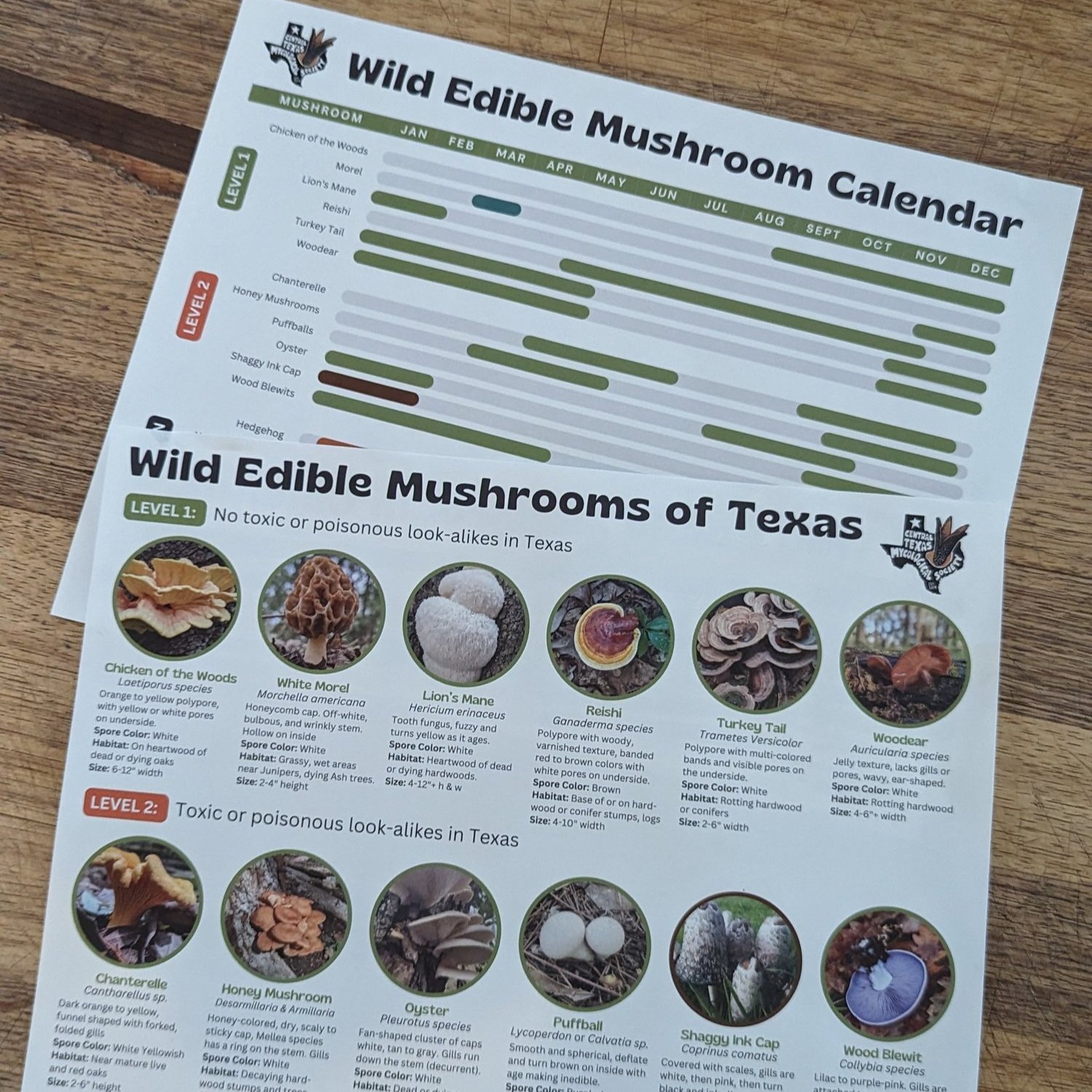
Comes with download of a Wild Edible Mushroom Calendar.
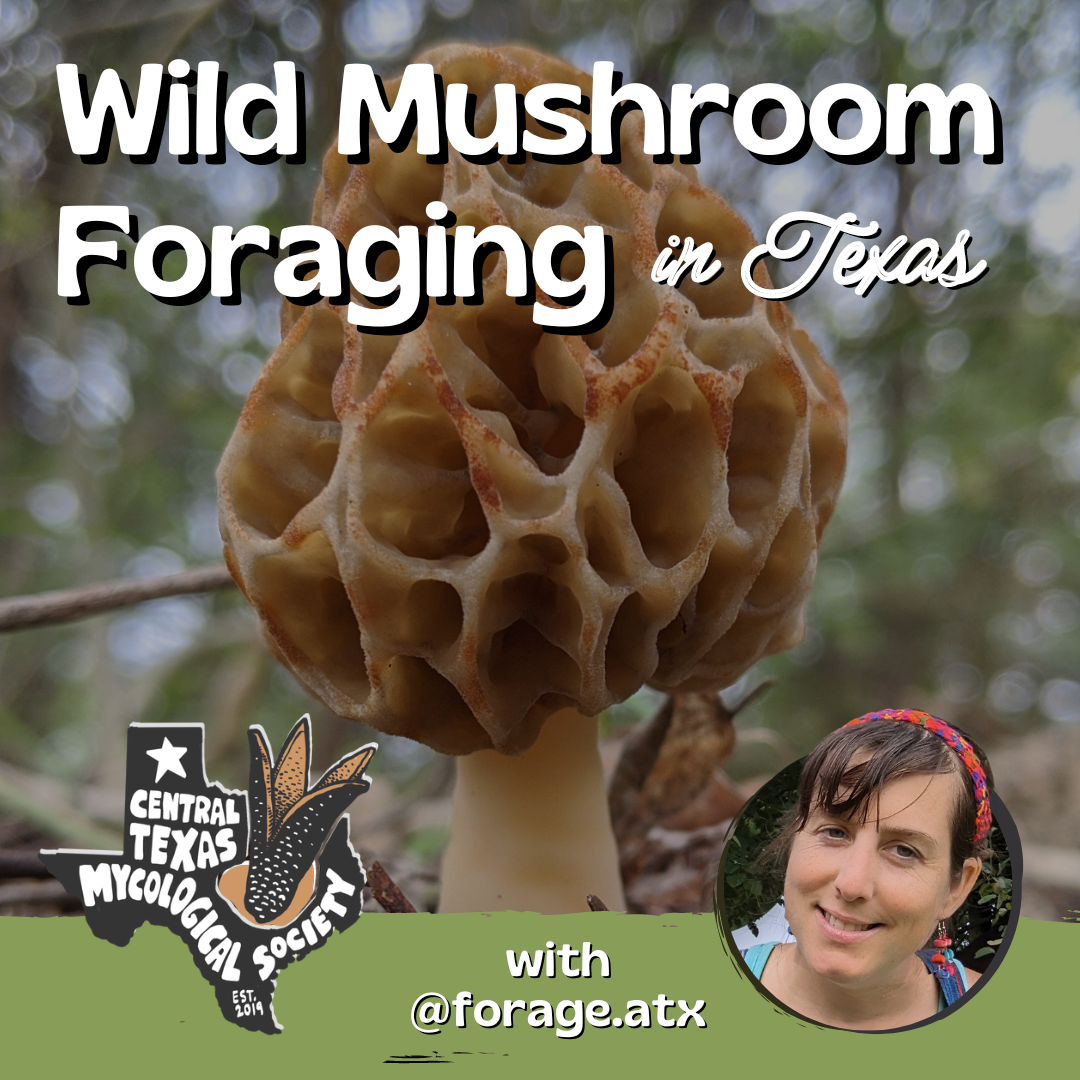

True Morel, Morchella americana
Description: Honeycomb cap with a off-white, bulbous, wrinkly stem. Hollow on inside. Fruits after rain and while soil temps are between 45-50°.
Habitat: Found in alkaline soils near limestone and cedar duff.
Spore Color: Creamy Yellow Size: 1–4" in Height
Edibility: Edible when cooked and toxic when raw
Look-alikes: Gyromitra, Verpa , Helvella genera have some toxic species. Get confirmation with expert before eating. Death by morels is real.
As the dewberries blossom, the choice edible morel, starts to fruit in Central Texas. These distinctive fungi have a honeycomb appearance due to the network of ridges with pits composing their caps. I'm already thinking about how to preserve morels so I can pair them with dewberries.
I found my first morels in Texas in 2019 as the pandemic shut everything down. SXSW was canceled and in my new found free-time I wandered near creeks looking under junipers for the honeycombed, yellow mushrooms. Morels are found to be saprophytic, mycorrhizal and endophytes during different parts of their life cycle. In Texas, I have found morels in riparian areas growing in limestone with grasses and duff near cedars or Juniperus ashei, hackberries, possomhaw, and cedar elms. They are illusive and require moisture from rain. The last few years have been really terrible for morels because of the severe droughts in Central Texas. There is a lot of hope for this morel season because they need at least six weeks of freezing temperatures to grow but obviously they have adapted to our shorter winters in Texas.

Wood Blewit Collybia species, formerly Lepista, Clitocybe
Description: Lilac to purple-pink. Gills are attached to short, stout stem with bulbous base.
Habitat: Grows in and decomposes leaf duff
Size: 3-6" cap diamter Spore Color: Light pink to white
Edibility: Good. Try in breakfast tacos
Look-alikes: Purple webcaps in the Cortinarius genus can be toxic and grow in same habitat. Spore print is rust colored.

OYSTER Pleurotus ostreatus
DESCRIPTION: Color can vary white, tan and gray.White to cream gills, run down stem.
HABITAT: Grows in clusters and decomposes hardwood.
SPORE COLOR: White
SIZE: Cap fan shaped, 2"-8" across.
EDIBILITY: Choice. Delicious meat replacement in all types of cuisines
LOOK A-LIKE: The Southern Jack-o-lantern, Omphalotus subilludens is the toxic look-a-like and is orange to brown in color. They do grow at the same time but their habitat and morphology is different.

Shoehorn Oyster Hohenbuehelia petaloides
Description: Pale to brown funnel-shaped caps with decurrent gills. Considered carnivorous because it traps nematodes with “sticky knobs” in the mycelium to obtain nitrogen and grow.
Habitat: Fruits after rain in mulch or woody debris
Spore Color: white or yellowish Size: 5-10" wide
Edibility: Edible when cooked but can be tough and mealy
Look-alikes: Pluerotus species or Lentinellus cochleatus (none observed in Texas) but grow on decomposing wood.

WOOD EAR Auricularia 6+- species in Texas
DESCRIPTION: Brown to amber in color. Jelly texture that is irregular, wavy, and ear-shaped. Lacks gills or pores.
HABITAT: Grows in clusters on decaying hardwood after rain
SPORE COLOR: White
SIZE: 4-6" in width and > 1/4" thick
EDIBILITY: Wood ear mushrooms are a popular ingredient in many Chinese dishes, such as hot and sour soup, and also used in Chinese medicine. It is also used in Ghana, as a blood tonic. Modern research into possible medical applications has variously concluded that wood ear has anti-tumor, hypoglycemic, anticoagulant and cholesterol-lowering properties.
LOOK-ALIKES: Amber Jelly, Exidia recisa which is also edible.

Puffball: Lycoperdon and Calvatia, 15+- species in Texas
DESCRIPTION: Smooth and spherical, deflate and turn purplish or brown on inside with age making inedible. Some peal and have spines.
HABITAT: Overgrazed Prairie or grasslands.
SPORE COLOR: Purple-brown
SIZE: 2- 60" diameter
EDIBILITY: Doesn’t have a strong flavor of its own and absorb flavors. Try making a Giant Puffball Pizza.
LOOK-ALIKES: Amanita species which can contain toxins and be fatal. If center of puffball is not white, it can cause GI distress.

TURKEY TAIL Trametes versicolor
DESCRIPTION: Variable coloration, distinct striping pattern. No gills, pores are small and round, white to light brown
HABITAT: Grows in overlapping clusters on logs and stumps
SPORE COLOR: White
SIZE: Cap fan shaped, 2"-8" across.
EDIBILITY: Medicinal. Tough, leathery flesh. Can be brewed into a tea, broth, or extracted into a tincture.
LOOK A-LIKE: False turkey tail. or Stereum ostrea and is non-toxic. Mushroom Expert has a useful check list to determine if it is true medicinal turkey tail.
Become a member and learn more about wild mushroom foraging in Texas!
Membership benefits include early access and discounts to walks, workshops, and more. Your membership helps support the larger community! Tag us to get help with ID and add your observations to iNaturalist.org. If you are trying a new mushroom, confirm the ID with an expert, then try a small amount to make sure you don't have an allergic reaction. Texas Mushroom Identification Facebook group is great for quick responses and ID help. Also, don't forget to add your finds on the Mushrooms of Texas project on iNaturalist.
Follow my adventures @forage.atx.

February Mushroom of the Month: Many-rooted Earthball, Scleroderma polyrhizum
The February of the Month is the Many-rooted earthball, Scleroderma polyrhizum
🍄⭐The February mushroom of the month is the Many-rooted Earthball, Scleroderma polyrhizum.
🙌 to Mike Ryon for correctly identifying this mushroom and the newest member of the society.
You can also be a supporting member to stay dialed-in with events & discover next month’s mystery mushroom.
What is that?
Dead Man's Hand, Earthstar Scleroderma, Many-rooted Earthball are all common names for Scleroderma polyrhizum, a basidiomycete fungus and a member of the genus Scleroderma, or "earthballs". They don’t really look like a typical mushroom, and many find themselves scratching their heads when first encountering one, trying to figure out what exactly it is. When they first emerge from the ground, they look like a rock. When they finally open, they look like a melted/rotten Reese’s peanut butter cup.
Taxonomy & Ecology
Found in dry, sandy soils, this species begins completely buried before slowly forcing the soil aside as it cracks apart to form a rough, star-shaped body with a diameter of 12–15 cm (4.7–5.9 in). When unopened, the fruit body ranges in shape from round to flattened to somewhat irregular, sometimes with lobes. At the center is a dark, brownish spore mass. Many- rooted earthballs are widely distributed across Asia, Europe and the America’s wherever soil and climate is favorable.
are they edible?
It will likely come as no surprise that these mushrooms are not edible. Not only do they look icky, they contain toxins which can cause some serious gastric discomfort. However, Scleroderma polyrhizum fruit bodies have been used in Traditional Chinese medicine in the treatment of treatment of detumescence and hemostasis. Future research may reveal more uses for this fascinating fungi.
BECOME A SUPPORTING MEMBER & stay Dialed in with events & discover next month’s mystery mushroom


February Foraging Forecast
Learn wild, edible mushrooms fruiting in Texas after rain.
Learn wild, edible mushrooms fruiting in Texas after rain.
Comes with download of a Wild Edible Mushroom Calendar.
Wood Blewit Collybia species, formerly Lepista, Clitocybe
Description: Lilac to purple-pink. Gills are attached to short, stout stem with bulbous base.
Habitat: Grows in and decomposes leaf duff
Size: 3-6" cap diamter Spore Color: Light pink to white
Edibility: Good. Try in breakfast tacos
Look-alikes: Purple webcaps in the Cortinarius genus can be toxic and grow in same habitat. Spore print is rust colored.

Lion’s Mane, Hericium erinaceus
Lion’s mane is a choice edible mushroom that rarely grows in the wild in Central Texas. I have foraged it a few times and it fruits on the cankers of post oaks in Central Texas. It is more abundant in East Texas on decaying oaks.
DESCRIPTION: Tooth fungus, fuzzy and turns yellow as it ages.
HABITAT: Fruits on decomposing hardwood or heartwood or cankers of living post oak in the winter after rain. SPORE COLOR: White
SIZE: 4-12"+ h & w
EDIBILITY: Mildly sweet flavor, tender texture that mimics shellfish like scallops, crab, or lobster. Medicinal
LOOK A-LIKE: Hericium americanum, Bear's Head Tooth & Hericium Coralloides, Coral Tooth (Edible). Marshmallow polypore, Irpiciporus pachyodon (Inedible)
MEDICINAL BENEFITS
Not only does this mushroom taste delicious, it’s good for you. Lion’s mane mushrooms contain bioactive substances that have beneficial effects on the body, especially the brain, heart and gut. Scientific studies have found this mushroom may:
✨ Reduce Inflammation
✨ Relieve Depression and Anxiety
✨ Protect against dementia and Alzheimer's
✨ Protect Against Ulcers in the Digestive Tract
✨ Reduce Heart Disease Risk
✨ Help Manage Diabetes Symptoms
✨ Cancer Fighting Properties
Where to Buy
It is also cultivated by several local mushroom farms and available at farmers markets and groceries stores. You can also pick them up at various locations in Central Texas with our mushroom block giveaway program and get a second fruiting in the cool winter months.
Hi-Fi Myco and Cap City Shrooms at farmers markets and Central Market
SmallHold at Central Market, Whole Foods
Go here for a complete list of Texas mushroom companies.
OYSTER: Pleurotus ostreatus
DESCRIPTION: Color can vary white, tan and gray.White to cream gills, run down stem.
HABITAT: Grows in clusters and decomposes hardwood.
SPORE COLOR: White
SIZE: Cap fan shaped, 2"-8" across.
EDIBILITY: Choice. Delicious meat replacement in all types of cuisines
LOOK A-LIKE: The Southern Jack-o-lantern, Omphalotus subilludens is the toxic look-a-like and is orange to brown in color. They do grow at the same time but their habitat and morphology is different.

Ringless Honey Mushroom: Desarmillaria & ArmillariA Species
Ringless Honey Mushroom, Desarmillaria caespitosa will start been popping up all over Austin in large clusters at the bases of trees (when the clusters appear to be terrestrial they are actually growing from underground wood) in late summer and fall. This parasitic fungus is part of a genus that is the largest living organism ever found on this planet.
Description: Honey-colored, dry, scaly to sticky cap. Mellea species has a ring on the stem. Gills, some species have a ring.
Habitat: Grows in clusters on decaying hard-wood.
Spore Color: White
Size: 6" in Height
Edibility: Not Choice.
Look-alikes: Southern Jack-o-lantern, Omphalotus subilludens which is toxic and orange to brown in color.

REISHI: Ganoderma, 12 species in Texas
DESCRIPTION: Polypore with woody, varnished texture, banded red to brown colors with white pores on underside.
HABITAT: Grows at base or on hardwood stumps, logs, especially oaks and pecan. Pines in East Texas.
SPORE COLOR: Brown
SIZE: 4-10" width
EDIBILITY: Medicinal. Very bitter because of medicinal compounds.
LOOK-ALIKES: Red-Belted Conk, Fomitosis Pinicola (also medicinal).

Witches Butter. Tremella mesenterica
Description: Bright yellow, parasitic jelly fungus
Habitat: Found on angiosperm bark and feeds on wood-decay fungi in the genus Peniophora consuming them as it grows.
Spore Color: White to Yellow Size: up to 3"
Edibility: Edible and flavorless. Studies suggest antitumor, antioxidative, and antiallergenic. Candied witch’s butter, resembling sour gummy candy, is a delightful treat packed with health benefits.
Look a-likes: Golden Ear or Tremella aurantia, Orange jelly or Dacrymyces palmatus and Fan-shaped Jelly Fungus or Dacryopinax spathularia are all edible.
WOOD EAR: Auricularia 6+- species in Texas
DESCRIPTION: Brown to amber in color. Jelly texture that is irregular, wavy, and ear-shaped. Lacks gills or pores.
HABITAT: Grows in clusters on decaying hardwood after rain
SPORE COLOR: White
SIZE: 4-6" in width and > 1/4" thick
EDIBILITY: Wood ear mushrooms are a popular ingredient in many Chinese dishes, such as hot and sour soup, and also used in Chinese medicine. It is also used in Ghana, as a blood tonic. Modern research into possible medical applications has variously concluded that wood ear has anti-tumor, hypoglycemic, anticoagulant and cholesterol-lowering properties.
LOOK-ALIKES: Amber Jelly, Exidia recisa which is also edible.
Puffball: Lycoperdon and Calvatia, 15+- species in Texas
DESCRIPTION: Smooth and spherical, deflate and turn purplish or brown on inside with age making inedible. Some peal and have spines.
HABITAT: Overgrazed Prairie or grasslands.
SPORE COLOR: Purple-brown
SIZE: 2- 60" diameter
EDIBILITY: Doesn’t have a strong flavor of its own and absorb flavors. Try making a Giant Puffball Pizza.
LOOK-ALIKES: Amanita species which can contain toxins and be fatal. If center of puffball is not white, it can cause GI distress.
TURKEY TAIL Trametes versicolor
DESCRIPTION: Variable coloration, distinct striping pattern. No gills, pores are small and round, white to light brown
HABITAT: Grows in overlapping clusters on logs and stumps
SPORE COLOR: White
SIZE: Cap fan shaped, 2"-8" across.
EDIBILITY: Medicinal. Tough, leathery flesh. Can be brewed into a tea, broth, or extracted into a tincture.
LOOK A-LIKE: False turkey tail. or Stereum ostrea and is non-toxic. Mushroom Expert has a useful check list to determine if it is true medicinal turkey tail.
Become a member and learn more about wild mushroom foraging in Texas!
Membership benefits include early access and discounts to walks, workshops, and more. Your membership helps support the larger community! Tag us to get help with ID and add your observations to iNaturalist.org. If you are trying a new mushroom, confirm the ID with an expert, then try a small amount to make sure you don't have an allergic reaction. Texas Mushroom Identification Facebook group is great for quick responses and ID help. Also, don't forget to add your finds on the Mushrooms of Texas project on iNaturalist.
Follow my adventures @forage.atx.

January Mushroom of the Month: Mulch Maids, Leratiomyces percevalii
The January of the Month for November is the Mulch Maid, Leratiomyces percevalii


🍄⭐The January mushroom of the month is the Mulch Maid, Leratiomyces percevalli.
🙌 to Scott for naming that mushroom correctly and becoming the newest member of Central Texas Mycology!
You can also be a supporting member to stay dialed-in with events & discover next month’s mystery mushroom.
What’s that growing in my mulch pile?
Leratiomyces percevalii, commonly known as Mulch Maids, are a common companion of mulch piles, waste places, grassy areas, and woodchips. Growing throughout North and South America, Europe, Asia and Australia, these saprobic mushrooms are small but mighty decomposers. It is unclear whether these mushrooms are natives of north America or more recent immigrants. However, their benefit to our ecosystems is undeniable.
How to ID mulch maids
Cap - 2.5-8 cm; convex to broadly convex or broadly bell-shaped; sticky when fresh but soon dry; honey yellow when young, quickly becoming yellowish, whitish, or dingy olive; smooth or finely hairy in places; the margin adorned with hanging white partial veil remnants, especially when young.
Gills - Attached to the stem or beginning run down it; close; whitish at first, becoming purplish gray to purple-black.
Stem - 4-13 cm long; up to about 1 cm thick; equal or tapered to base; dry; with a ring zone that darkens with falling spores; finely hairy; whitish, developing reddish brown discolorations from the base upwards; base usually hairy, with prominent mycelial threads.
Flesh: Whitish.
Spore Print - Dark purple-brown to blackish.
are they edible?
Mulch maids are not known to be poisonous but nor are they considered forgeable. It is reported that they have a radish like flavor, though it is not recommended to experiment with unknown mushrooms.
A similar looking species that grows in similar habitat is Agrocybe praecox, the spring fieldcap, a species that looks similar but blooms in the spring instead of the fall.
BECOME A SUPPORTING MEMBER & stay Dialed in with events & discover next month’s mystery mushroom

January Foraging Forecast
Learn wild, edible mushrooms fruiting in Texas after rain.
Learn wild, edible mushrooms fruiting in Texas after rain.
Comes with download of a Wild Edible Mushroom Calendar.
Wood Blewit Collybia species, formerly Lepista, Clitocybe
Description: Lilac to purple-pink. Gills are attached to short, stout stem with bulbous base.
Habitat: Grows in and decomposes leaf duff
Size: 3-6" cap diamter Spore Color: Light pink to white
Edibility: Good. Try in breakfast tacos
Look-alikes: Purple webcaps in the Cortinarius genus can be toxic and grow in same habitat. Spore print is rust colored.
Lion’s Mane, Hericium erinaceus
Lion’s mane is a choice edible mushroom that rarely grows in the wild in Central Texas. I have foraged it a few times and it fruits on the cankers of post oaks in Central Texas. It is more abundant in East Texas on decaying oaks.
DESCRIPTION: Tooth fungus, fuzzy and turns yellow as it ages.
HABITAT: Fruits on decomposing hardwood or heartwood or cankers of living post oak in the winter after rain. SPORE COLOR: White
SIZE: 4-12"+ h & w
EDIBILITY: Mildly sweet flavor, tender texture that mimics shellfish like scallops, crab, or lobster. Medicinal
LOOK A-LIKE: Hericium americanum, Bear's Head Tooth & Hericium Coralloides, Coral Tooth (Edible). Marshmallow polypore, Irpiciporus pachyodon (Inedible)
MEDICINAL BENEFITS
Not only does this mushroom taste delicious, it’s good for you. Lion’s mane mushrooms contain bioactive substances that have beneficial effects on the body, especially the brain, heart and gut. Scientific studies have found this mushroom may:
✨ Reduce Inflammation
✨ Relieve Depression and Anxiety
✨ Protect against dementia and Alzheimer's
✨ Protect Against Ulcers in the Digestive Tract
✨ Reduce Heart Disease Risk
✨ Help Manage Diabetes Symptoms
✨ Cancer Fighting Properties
Where to Buy
It is also cultivated by several local mushroom farms and available at farmers markets and groceries stores. You can also pick them up at various locations in Central Texas with our mushroom block giveaway program and get a second fruiting in the cool winter months.
Hi-Fi Myco and Cap City Shrooms at farmers markets and Central Market
SmallHold at Central Market, Whole Foods
Go here for a complete list of Texas mushroom companies.
OYSTER: Pleurotus ostreatus
DESCRIPTION: Color can vary white, tan and gray.White to cream gills, run down stem.
HABITAT: Grows in clusters and decomposes hardwood.
SPORE COLOR: White
SIZE: Cap fan shaped, 2"-8" across.
EDIBILITY: Choice. Delicious meat replacement in all types of cuisines
LOOK A-LIKE: The Southern Jack-o-lantern, Omphalotus subilludens is the toxic look-a-like and is orange to brown in color. They do grow at the same time but their habitat and morphology is different.

Chicken of the Woods: Laetiporus, 4 species in texas
Description: Orange to yellow polypore, with yellow or white pores on underside.
Habitat: Grows in shelfs on heartwood of dead or dying oaks.
Spore Color: White Size: 6-12" width
Edibility: Contains proteins, fat, fiber and tastes just like chicken! Harvest when young, colorful, and moist. Becomes lighter in color, fiborus, mealy and dry, inedible with age.
Look-alikes: Shaggy Bracket, Inonotus hispidus (non-toxic)
Ringless Honey Mushroom: Desarmillaria & ArmillariA Species
Ringless Honey Mushroom, Desarmillaria caespitosa will start been popping up all over Austin in large clusters at the bases of trees (when the clusters appear to be terrestrial they are actually growing from underground wood) in late summer and fall. This parasitic fungus is part of a genus that is the largest living organism ever found on this planet.
Description: Honey-colored, dry, scaly to sticky cap. Mellea species has a ring on the stem. Gills, some species have a ring.
Habitat: Grows in clusters on decaying hard-wood.
Spore Color: White
Size: 6" in Height
Edibility: Not Choice.
Look-alikes: Southern Jack-o-lantern, Omphalotus subilludens which is toxic and orange to brown in color.
REISHI: Ganoderma, 12 species in Texas
DESCRIPTION: Polypore with woody, varnished texture, banded red to brown colors with white pores on underside.
HABITAT: Grows at base or on hardwood stumps, logs, especially oaks and pecan. Pines in East Texas.
SPORE COLOR: Brown
SIZE: 4-10" width
EDIBILITY: Medicinal. Very bitter because of medicinal compounds.
LOOK-ALIKES: Red-Belted Conk, Fomitosis Pinicola (also medicinal).
Witches Butter. Tremella mesenterica
Description: Bright yellow, parasitic jelly fungus
Habitat: Found on angiosperm bark and feeds on wood-decay fungi in the genus Peniophora consuming them as it grows.
Spore Color: White to Yellow Size: up to 3"
Edibility: Edible and flavorless. Studies suggest antitumor, antioxidative, and antiallergenic. Candied witch’s butter, resembling sour gummy candy, is a delightful treat packed with health benefits.
Look a-likes: Golden Ear or Tremella aurantia, Orange jelly or Dacrymyces palmatus and Fan-shaped Jelly Fungus or Dacryopinax spathularia are all edible.
WOOD EAR: Auricularia 6+- species in Texas
DESCRIPTION: Brown to amber in color. Jelly texture that is irregular, wavy, and ear-shaped. Lacks gills or pores.
HABITAT: Grows in clusters on decaying hardwood after rain
SPORE COLOR: White
SIZE: 4-6" in width and > 1/4" thick
EDIBILITY: Wood ear mushrooms are a popular ingredient in many Chinese dishes, such as hot and sour soup, and also used in Chinese medicine. It is also used in Ghana, as a blood tonic. Modern research into possible medical applications has variously concluded that wood ear has anti-tumor, hypoglycemic, anticoagulant and cholesterol-lowering properties.
LOOK-ALIKES: Amber Jelly, Exidia recisa which is also edible.
Puffball: Lycoperdon and Calvatia, 15+- species in Texas
DESCRIPTION: Smooth and spherical, deflate and turn purplish or brown on inside with age making inedible. Some peal and have spines.
HABITAT: Overgrazed Prairie or grasslands.
SPORE COLOR: Purple-brown
SIZE: 2- 60" diameter
EDIBILITY: Doesn’t have a strong flavor of its own and absorb flavors. Try making a Giant Puffball Pizza.
LOOK-ALIKES: Amanita species which can contain toxins and be fatal. If center of puffball is not white, it can cause GI distress.
TURKEY TAIL Trametes versicolor
DESCRIPTION: Variable coloration, distinct striping pattern. No gills, pores are small and round, white to light brown
HABITAT: Grows in overlapping clusters on logs and stumps
SPORE COLOR: White
SIZE: Cap fan shaped, 2"-8" across.
EDIBILITY: Medicinal. Tough, leathery flesh. Can be brewed into a tea, broth, or extracted into a tincture.
LOOK A-LIKE: False turkey tail. or Stereum ostrea and is non-toxic. Mushroom Expert has a useful check list to determine if it is true medicinal turkey tail.
Become a member and learn more about wild mushroom foraging in Texas!
Membership benefits include early access and discounts to walks, workshops, and more. Your membership helps support the larger community! Tag us to get help with ID and add your observations to iNaturalist.org. If you are trying a new mushroom, confirm the ID with an expert, then try a small amount to make sure you don't have an allergic reaction. Texas Mushroom Identification Facebook group is great for quick responses and ID help. Also, don't forget to add your finds on the Mushrooms of Texas project on iNaturalist.