
January Foraging Forecast
Learn wild, edible mushrooms fruiting in Texas after rain.
Learn wild, edible mushrooms fruiting in Texas after rain.
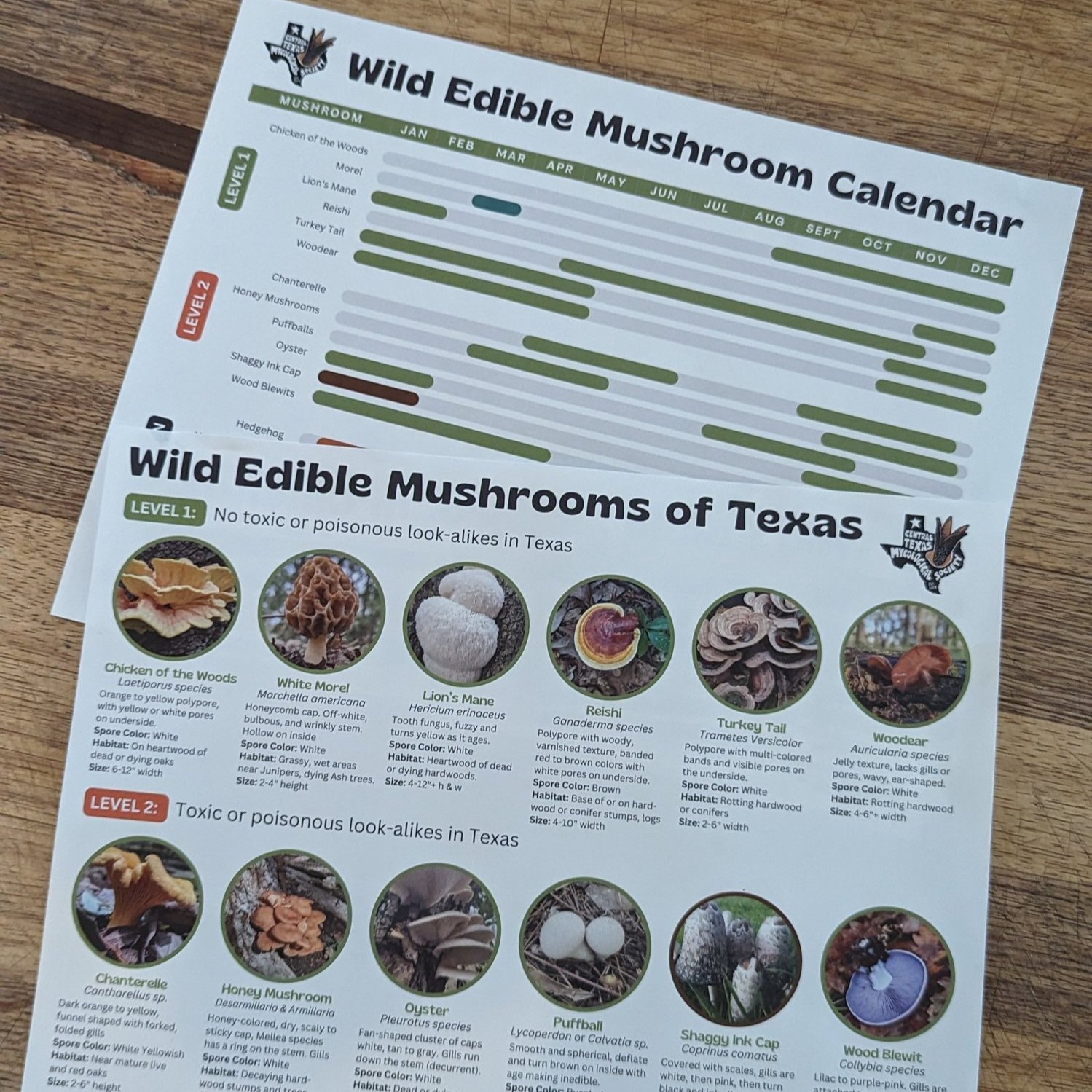
Comes with download of a Wild Edible Mushroom Calendar.
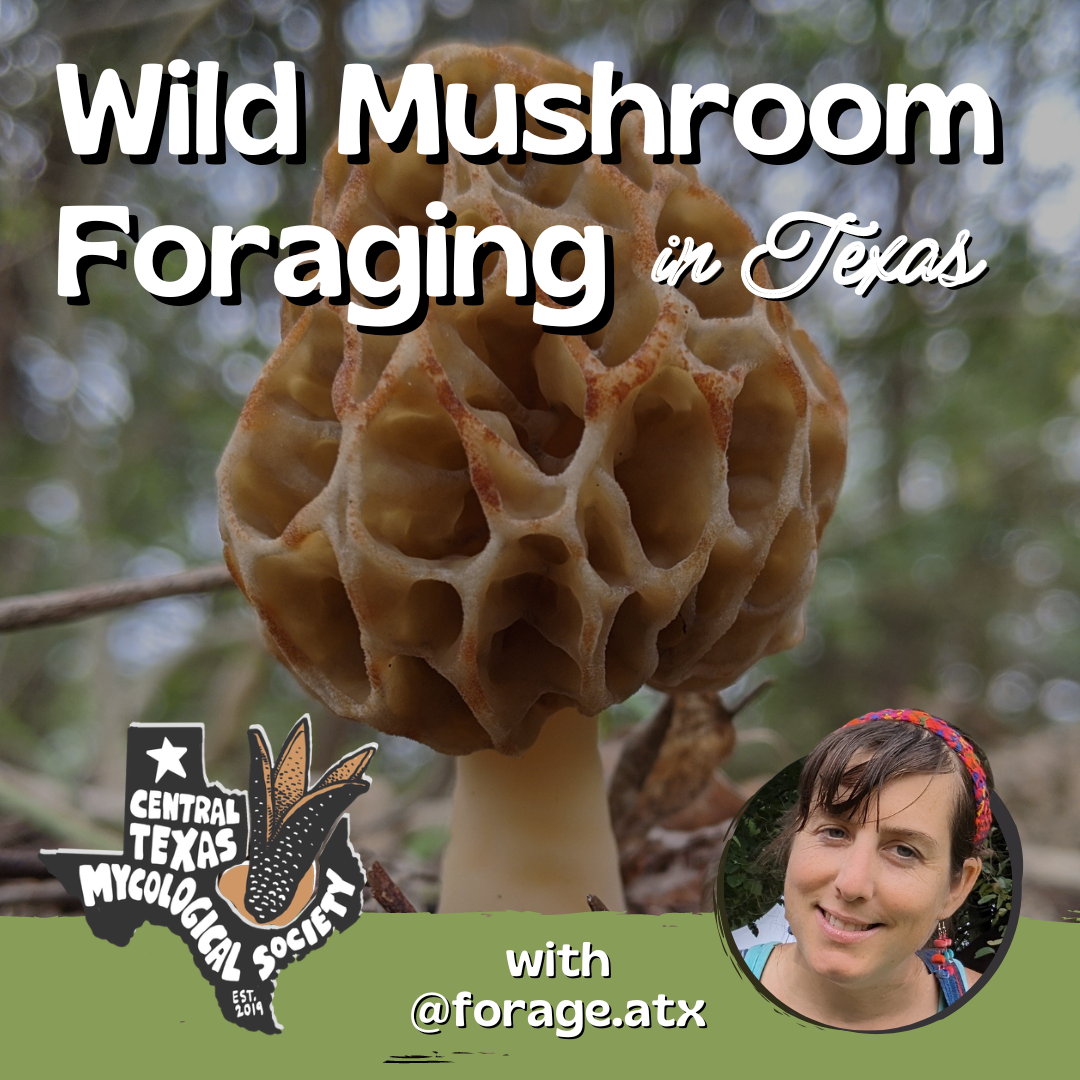

Wood Blewit Collybia species, formerly Lepista, Clitocybe
Description: Lilac to purple-pink. Gills are attached to short, stout stem with bulbous base.
Habitat: Grows in and decomposes leaf duff
Size: 3-6" cap diamter Spore Color: Light pink to white
Edibility: Good. Try in breakfast tacos
Look-alikes: Purple webcaps in the Cortinarius genus can be toxic and grow in same habitat. Spore print is rust colored.

Lion’s Mane, Hericium erinaceus
Lion’s mane is a choice edible mushroom that rarely grows in the wild in Central Texas. I have foraged it a few times and it fruits on the cankers of post oaks in Central Texas. It is more abundant in East Texas on decaying oaks.
DESCRIPTION: Tooth fungus, fuzzy and turns yellow as it ages.
HABITAT: Fruits on decomposing hardwood or heartwood or cankers of living post oak in the winter after rain. SPORE COLOR: White
SIZE: 4-12"+ h & w
EDIBILITY: Mildly sweet flavor, tender texture that mimics shellfish like scallops, crab, or lobster. Medicinal
LOOK A-LIKE: Hericium americanum, Bear's Head Tooth & Hericium Coralloides, Coral Tooth (Edible). Marshmallow polypore, Irpiciporus pachyodon (Inedible)
MEDICINAL BENEFITS
Not only does this mushroom taste delicious, it’s good for you. Lion’s mane mushrooms contain bioactive substances that have beneficial effects on the body, especially the brain, heart and gut. Scientific studies have found this mushroom may:
✨ Reduce Inflammation
✨ Relieve Depression and Anxiety
✨ Protect against dementia and Alzheimer's
✨ Protect Against Ulcers in the Digestive Tract
✨ Reduce Heart Disease Risk
✨ Help Manage Diabetes Symptoms
✨ Cancer Fighting Properties
Where to Buy
It is also cultivated by several local mushroom farms and available at farmers markets and groceries stores. You can also pick them up at various locations in Central Texas with our mushroom block giveaway program and get a second fruiting in the cool winter months.
Hi-Fi Myco and Cap City Shrooms at farmers markets and Central Market
SmallHold at Central Market, Whole Foods
Go here for a complete list of Texas mushroom companies.

OYSTER: Pleurotus ostreatus
DESCRIPTION: Color can vary white, tan and gray.White to cream gills, run down stem.
HABITAT: Grows in clusters and decomposes hardwood.
SPORE COLOR: White
SIZE: Cap fan shaped, 2"-8" across.
EDIBILITY: Choice. Delicious meat replacement in all types of cuisines
LOOK A-LIKE: The Southern Jack-o-lantern, Omphalotus subilludens is the toxic look-a-like and is orange to brown in color. They do grow at the same time but their habitat and morphology is different.

Chicken of the Woods: Laetiporus, 4 species in texas
Description: Orange to yellow polypore, with yellow or white pores on underside.
Habitat: Grows in shelfs on heartwood of dead or dying oaks.
Spore Color: White Size: 6-12" width
Edibility: Contains proteins, fat, fiber and tastes just like chicken! Harvest when young, colorful, and moist. Becomes lighter in color, fiborus, mealy and dry, inedible with age.
Look-alikes: Shaggy Bracket, Inonotus hispidus (non-toxic)

Ringless Honey Mushroom: Desarmillaria & ArmillariA Species
Ringless Honey Mushroom, Desarmillaria caespitosa will start been popping up all over Austin in large clusters at the bases of trees (when the clusters appear to be terrestrial they are actually growing from underground wood) in late summer and fall. This parasitic fungus is part of a genus that is the largest living organism ever found on this planet.
Description: Honey-colored, dry, scaly to sticky cap. Mellea species has a ring on the stem. Gills, some species have a ring.
Habitat: Grows in clusters on decaying hard-wood.
Spore Color: White
Size: 6" in Height
Edibility: Not Choice.
Look-alikes: Southern Jack-o-lantern, Omphalotus subilludens which is toxic and orange to brown in color.

REISHI: Ganoderma, 12 species in Texas
DESCRIPTION: Polypore with woody, varnished texture, banded red to brown colors with white pores on underside.
HABITAT: Grows at base or on hardwood stumps, logs, especially oaks and pecan. Pines in East Texas.
SPORE COLOR: Brown
SIZE: 4-10" width
EDIBILITY: Medicinal. Very bitter because of medicinal compounds.
LOOK-ALIKES: Red-Belted Conk, Fomitosis Pinicola (also medicinal).

Witches Butter. Tremella mesenterica
Description: Bright yellow, parasitic jelly fungus
Habitat: Found on angiosperm bark and feeds on wood-decay fungi in the genus Peniophora consuming them as it grows.
Spore Color: White to Yellow Size: up to 3"
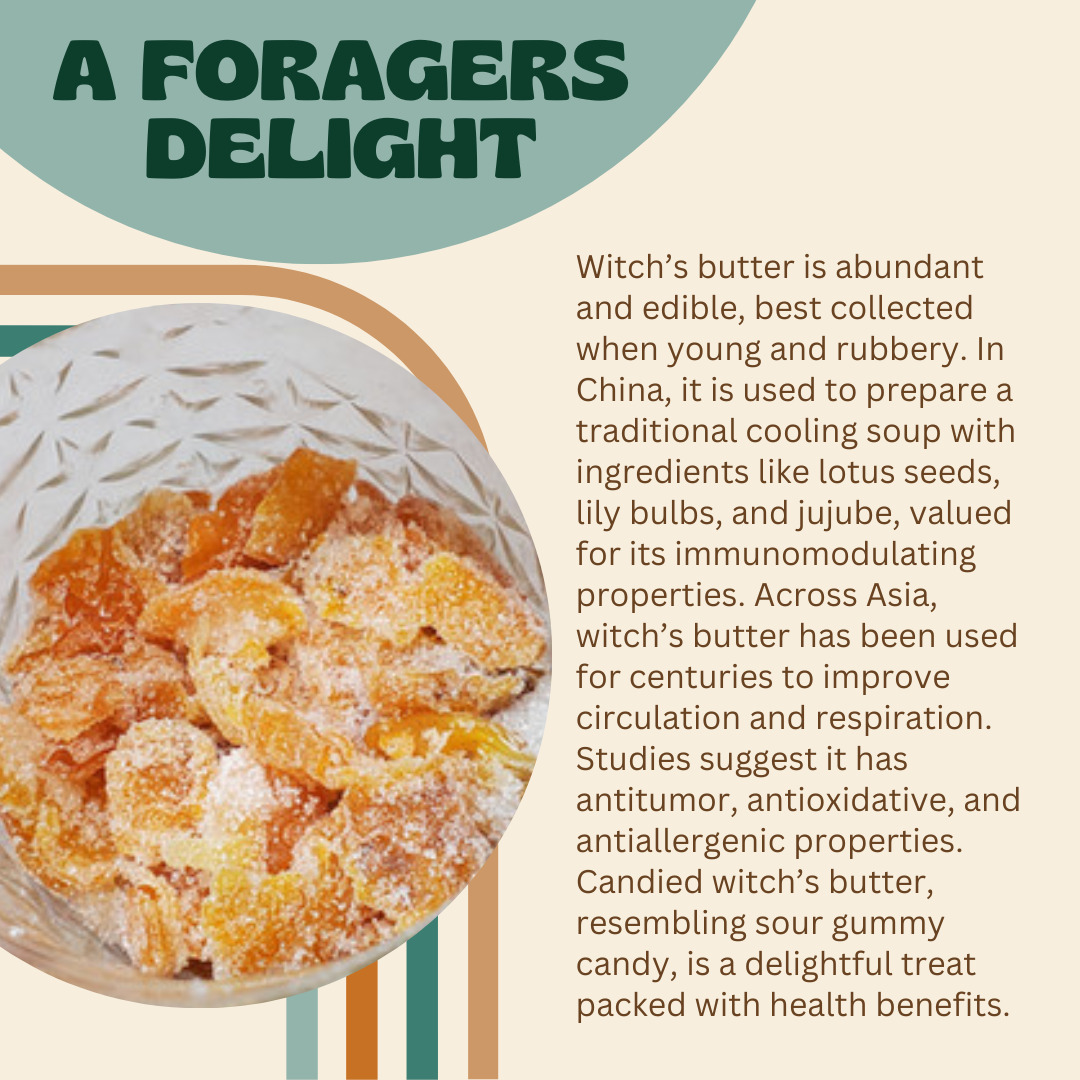
Edibility: Edible and flavorless. Studies suggest antitumor, antioxidative, and antiallergenic. Candied witch’s butter, resembling sour gummy candy, is a delightful treat packed with health benefits.
Look a-likes: Golden Ear or Tremella aurantia, Orange jelly or Dacrymyces palmatus and Fan-shaped Jelly Fungus or Dacryopinax spathularia are all edible.

WOOD EAR: Auricularia 6+- species in Texas
DESCRIPTION: Brown to amber in color. Jelly texture that is irregular, wavy, and ear-shaped. Lacks gills or pores.
HABITAT: Grows in clusters on decaying hardwood after rain
SPORE COLOR: White
SIZE: 4-6" in width and > 1/4" thick
EDIBILITY: Wood ear mushrooms are a popular ingredient in many Chinese dishes, such as hot and sour soup, and also used in Chinese medicine. It is also used in Ghana, as a blood tonic. Modern research into possible medical applications has variously concluded that wood ear has anti-tumor, hypoglycemic, anticoagulant and cholesterol-lowering properties.
LOOK-ALIKES: Amber Jelly, Exidia recisa which is also edible.

Puffball: Lycoperdon and Calvatia, 15+- species in Texas
DESCRIPTION: Smooth and spherical, deflate and turn purplish or brown on inside with age making inedible. Some peal and have spines.
HABITAT: Overgrazed Prairie or grasslands.
SPORE COLOR: Purple-brown
SIZE: 2- 60" diameter
EDIBILITY: Doesn’t have a strong flavor of its own and absorb flavors. Try making a Giant Puffball Pizza.
LOOK-ALIKES: Amanita species which can contain toxins and be fatal. If center of puffball is not white, it can cause GI distress.

TURKEY TAIL Trametes versicolor
DESCRIPTION: Variable coloration, distinct striping pattern. No gills, pores are small and round, white to light brown
HABITAT: Grows in overlapping clusters on logs and stumps
SPORE COLOR: White
SIZE: Cap fan shaped, 2"-8" across.
EDIBILITY: Medicinal. Tough, leathery flesh. Can be brewed into a tea, broth, or extracted into a tincture.
LOOK A-LIKE: False turkey tail. or Stereum ostrea and is non-toxic. Mushroom Expert has a useful check list to determine if it is true medicinal turkey tail.
Become a member and learn more about wild mushroom foraging in Texas!
Membership benefits include early access and discounts to walks, workshops, and more. Your membership helps support the larger community! Tag us to get help with ID and add your observations to iNaturalist.org. If you are trying a new mushroom, confirm the ID with an expert, then try a small amount to make sure you don't have an allergic reaction. Texas Mushroom Identification Facebook group is great for quick responses and ID help. Also, don't forget to add your finds on the Mushrooms of Texas project on iNaturalist.
Follow my adventures @forage.atx.

2024: Another Magical Year of Mycelial Growth
2024 has been a true underground adventure—myceliating through rich soils, spreading spores like rebellious devil’s cigars bursting into cosmic stardom.
2024 has been a true underground adventure—myceliating through rich soils, spreading spores like rebellious devil’s cigars bursting into cosmic stardom. Since our scrappy nonprofit sprouted in 2019, we’ve been 100% volunteer-powered, a scrappy fungal network organizing community outreach, creative programming, and a recycling program that turns waste into magic.

Record Membership
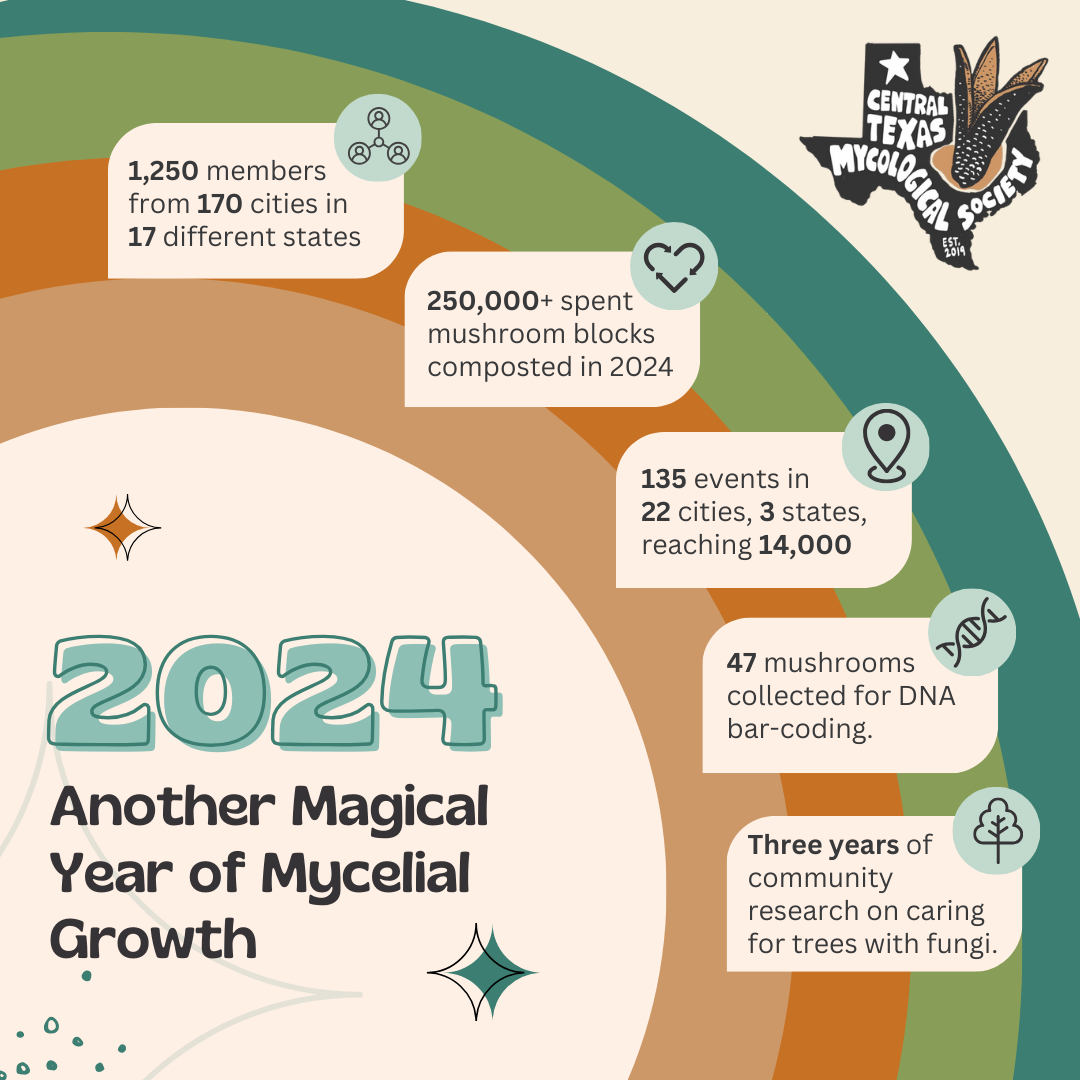
Membership has grown to over 1,250+ supporters from 170 cities in 17 different states. You can support us by with a individual or family membership, by volunteering, or making a one-time donation. Volunteers are automatic members and get 50% discount on merch and event tickets.
250,000+ Blocks Composted
Mountains of “spent mushroom blocks” have been rescued from the waste and are myceliating, growing mushrooms, building healthy soil and community. An estimated that 250,000+ blocks have been composted annually in Central Texas. We are grateful for the donations and over 250 volunteers.
Record No. of Education Events
We had 135 education events including mushroom walks, talks, block giveaways, and workshops in 22 cities and 3 states, reaching over 14,000 students. The mycelium is running in Houston, San Antonio, Bastrop, Boerne, Waco with many events in the Austin area. Next year we plan to reach even more cities and counties in Texas.
DNA Barcoding Mushrooms
Late this year we began collecting mushrooms of Texas to monitor diversity and add observations with DNA bar-coding to MycoMap, a project by Mycota Labs. So far we have collected 47 species and this next year we will be collaborating with ACC students and doing more collection walks.
Health Soils, Healthy Trees
We wrapped up the third year of Healthy Soil, Healthy Trees, a partnership with City of Austin Urban Forestry Dept., Ecology Action. Next year we will be working with TreeFolks to conduct community research on mycorrhizal relationships in urban reforestation efforts. We will continue to do research through 2025 so keep an eye out for community workshops.
What’s in Store for 2025:
Spring Recipe Zine
DNA Barcoding of Texas Mushrooms
Camping Forays
Art Workshops
K-12 Lesson Plans
Let’s hope for more rain and then mushrooms! Join us in becoming a supporting member as we continue to be mesmerized by fungi!




Enter to Win a Texas Mushroom Tee
Your feedback is essential to us. Take a few moments to share your thoughts on this year’s educational events and be entered to win. Your response will help us improve future events and create a better experience for all!
How You Can Support
🧧Become a supporting member or give a membership gift card.
👕Purchase merch including our new Texas mushrooms tee with a design from Mystic Multiples.
✋Volunteer and help us keep organic matter out of the waste.
🍄 Give a ♻️🍄🧱 underneath your trees to protect them this coming winter.
💸 Make a donation to support mycology education and the recycling program.

December Mushroom of the Month: Witch’s Butter, Tremella mesenterica
The December of the Month for November is the Witch’s Butter, Tremella mesenterica
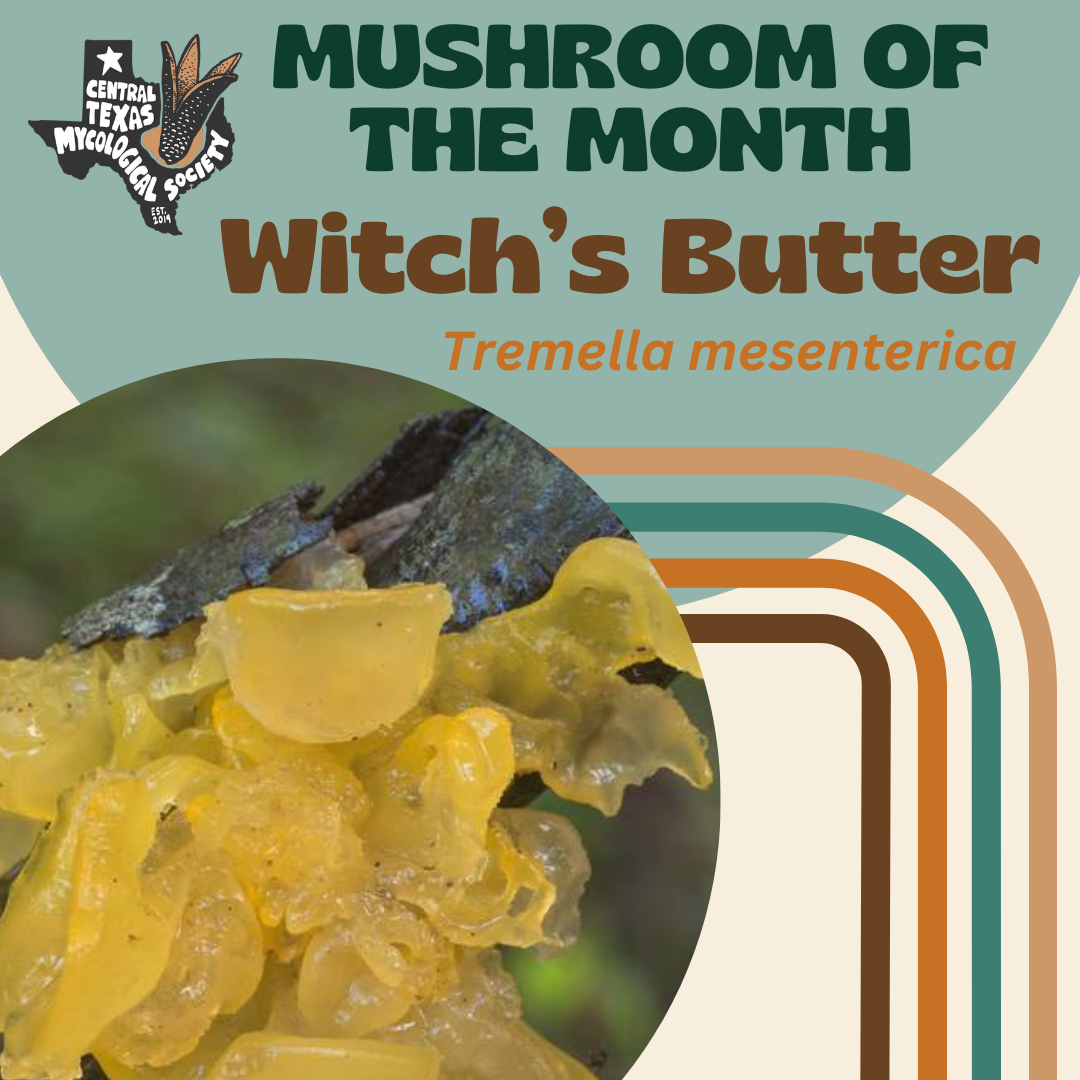



🍄⭐The December mushroom of the month is 𝘛𝘳𝘦𝘮𝘦𝘭𝘭𝘢 𝘮𝘦𝘴𝘦𝘯𝘵𝘦𝘳𝘪𝘤𝘢 commonly known as witches butter!
🙌 to Sanjay from Houston for naming that mushroom correctly and becoming the newest member of Central Texas Mycology!
You can also be a supporting member to stay dialed-in with events & discover next month’s mystery mushroom.
What’s That Gooey Glob?
During the cooler, wetter months of fall and winter, Tremella mesenterica, commonly known as witch's butter, appears as yellow, gelatinous masses on dead hardwood bark. Its fluorescent hue brightens the gloomy landscape, though the fungus feels tough and rubbery despite resembling jelly. Witch's butter is a parasitic jelly fungus that feeds on wood-decay fungi in the genus Peniophora, consuming them as it grows.
a foragers delight
Witch’s butter is abundant and edible, best collected when young and rubbery. In China, it is used to prepare a traditional cooling soup with ingredients like lotus seeds, lily bulbs, and jujube, valued for its immunomodulating properties. Across Asia, witch’s butter has been used for centuries to improve circulation and respiration. Studies suggest it has antitumor, antioxidative, and antiallergenic properties. Candied witch’s butter, resembling sour gummy candy, is a delightful treat packed with health benefits.
myth and legend
With a name like Witch’s Butter, it’s no surprise this fungus is steeped in myth and lore. According to European legend, it grows on the door frames of homes cursed by a witch’s hex.
The curse could only be lifted by piercing the fungus with a pin to drain its fluid. However, the fungus rehydrates with the next rain, which seemed ominous to superstitious residents. Today, we understand Witch’s Butter as a fascinating natural ally rather than a harbinger of doom.
BECOME A SUPPORTING MEMBER & stay Dialed in with events & discover next month’s mystery mushroom

December Foraging Forecast
Learn wild, edible mushrooms fruiting in Texas after rain.
Learn wild, edible mushrooms fruiting in Texas after rain.
Comes with download of a Wild Edible Mushroom Calendar.
Lion’s Mane, Hericium erinaceus
Lion’s mane is a choice edible mushroom that rarely grows in the wild in Central Texas. I have foraged it a few times and it fruits on the cankers of post oaks in Central Texas. It is more abundant in East Texas on decaying oaks.
DESCRIPTION: Tooth fungus, fuzzy and turns yellow as it ages.
HABITAT: Fruits on decomposing hardwood or heartwood or cankers of living post oak in the winter after rain. SPORE COLOR: White
SIZE: 4-12"+ h & w
EDIBILITY: Mildly sweet flavor, tender texture that mimics shellfish like scallops, crab, or lobster. Medicinal
LOOK A-LIKE: Hericium americanum, Bear's Head Tooth & Hericium Coralloides, Coral Tooth (Edible). Marshmallow polypore, Irpiciporus pachyodon (Inedible)
MEDICINAL BENEFITS
Not only does this mushroom taste delicious, it’s good for you. Lion’s mane mushrooms contain bioactive substances that have beneficial effects on the body, especially the brain, heart and gut. Scientific studies have found this mushroom may:
✨ Reduce Inflammation
✨ Relieve Depression and Anxiety
✨ Protect against dementia and Alzheimer's
✨ Protect Against Ulcers in the Digestive Tract
✨ Reduce Heart Disease Risk
✨ Help Manage Diabetes Symptoms
✨ Cancer Fighting Properties
Where to Buy
It is also cultivated by several local mushroom farms and available at farmers markets and groceries stores. You can also pick them up at various locations in Central Texas with our mushroom block giveaway program and get a second fruiting in the cool winter months.
Hi-Fi Myco and Cap City Shrooms at farmers markets and Central Market
SmallHold at Central Market, Whole Foods
Go here for a complete list of Texas mushroom companies.
OYSTER: Pleurotus ostreatus
DESCRIPTION: Color can vary white, tan and gray.White to cream gills, run down stem.
HABITAT: Grows in clusters and decomposes hardwood.
SPORE COLOR: White
SIZE: Cap fan shaped, 2"-8" across.
EDIBILITY: Choice. Delicious meat replacement in all types of cuisines
LOOK A-LIKE: The Southern Jack-o-lantern, Omphalotus subilludens is the toxic look-a-like and is orange to brown in color. They do grow at the same time but their habitat and morphology is different.
Chicken of the Woods: Laetiporus, 4 species in texas
Description: Orange to yellow polypore, with yellow or white pores on underside.
Habitat: Grows in shelfs on heartwood of dead or dying oaks.
Spore Color: White Size: 6-12" width
Edibility: Contains proteins, fat, fiber and tastes just like chicken! Harvest when young, colorful, and moist. Becomes lighter in color, fiborus, mealy and dry, inedible with age.
Look-alikes: Shaggy Bracket, Inonotus hispidus (non-toxic)
Ringless Honey Mushroom: Desarmillaria & ArmillariA Species
Ringless Honey Mushroom, Desarmillaria caespitosa will start been popping up all over Austin in large clusters at the bases of trees (when the clusters appear to be terrestrial they are actually growing from underground wood) in late summer and fall. This parasitic fungus is part of a genus that is the largest living organism ever found on this planet.
Description: Honey-colored, dry, scaly to sticky cap. Mellea species has a ring on the stem. Gills, some species have a ring.
Habitat: Grows in clusters on decaying hard-wood.
Spore Color: White
Size: 6" in Height
Edibility: Not Choice.
Look-alikes: Southern Jack-o-lantern, Omphalotus subilludens which is toxic and orange to brown in color.
REISHI: Ganoderma, 12 species in Texas
DESCRIPTION: Polypore with woody, varnished texture, banded red to brown colors with white pores on underside.
HABITAT: Grows at base or on hardwood stumps, logs, especially oaks and pecan. Pines in East Texas.
SPORE COLOR: Brown
SIZE: 4-10" width
EDIBILITY: Medicinal. Very bitter because of medicinal compounds.
LOOK-ALIKES: Red-Belted Conk, Fomitosis Pinicola (also medicinal).

honeycomb fungus: FavoluS 3 species in Texas
DESCRIPTION: Genus of tropical fungi in the family Polyporaceae but with fleshy with radially arranged pores on the underside of the cap that are angular and deeply pitted, somewhat resembling a honeycomb. White to yellow and grows alone or in overlapping clusters similar to oyster mushrooms or other shelf fungi.
HABITAT: On decaying hard-wood, year round when humidity is high after rain.
SPORE COLOR: White
SIZE: 3-6" wide
EDIBILITY: Odor slightly foul, especially in rehydrated material; taste not distinctive. Tough texture and can be cooked like chicharrones.
LOOK A-LIKE: Oysters, Pluerotus or Lentinellus cochleatus (none observed in Texas) but grow on decomposing wood.
WOOD EAR: Auricularia 6+- species in Texas
DESCRIPTION: Brown to amber in color. Jelly texture that is irregular, wavy, and ear-shaped. Lacks gills or pores.
HABITAT: Grows in clusters on decaying hardwood after rain
SPORE COLOR: White
SIZE: 4-6" in width and > 1/4" thick
EDIBILITY: Wood ear mushrooms are a popular ingredient in many Chinese dishes, such as hot and sour soup, and also used in Chinese medicine. It is also used in Ghana, as a blood tonic. Modern research into possible medical applications has variously concluded that wood ear has anti-tumor, hypoglycemic, anticoagulant and cholesterol-lowering properties.
LOOK-ALIKES: Amber Jelly, Exidia recisa which is also edible.
Puffball: Lycoperdon and Calvatia, 15+- species in Texas
DESCRIPTION: Smooth and spherical, deflate and turn purplish or brown on inside with age making inedible. Some peal and have spines.
HABITAT: Overgrazed Prairie or grasslands.
SPORE COLOR: Purple-brown
SIZE: 2- 60" diameter
EDIBILITY: Doesn’t have a strong flavor of its own and absorb flavors. Try making a Giant Puffball Pizza.
LOOK-ALIKES: Amanita species which can contain toxins and be fatal. If center of puffball is not white, it can cause GI distress.

Blue Milkcap: Lactarius Indigo
DESCRIPTION: Blue cap with concentric rings and a depression in center, sticky or slimy to the touch. Brittle flesh, stem. Gills and body exude blue latex when injured tissue is and stains the wounded tissue greenish blue.
HABITAT: Mycorrhizal and grows in deciduous and coniferous forests.
SPORE COLOR: Cream
SIZE: 2.0–5.9" cap width
EDIBILITY: Choice. Peppery taste and has a coarse, grainy texture.
LOOK-ALIKES: Blewit, Collybia nuda or Lactarius paradoxus (edible)

CHANTERELLE: Cantharellus, 10+- species in Texas
DESCRIPTION: Red, orange, yellow to white, meaty and funnel-shaped and can be found in clusters or individual mushrooms. On the lower surface, underneath the smooth cap, most species have rounded, forked folds that run almost all the way down the stipe, which tapers down seamlessly from the cap.
HABITAT: Symbiotic and found around 5-30 feet of mature live and red oaks after a lot of rain. Chanterelles need a lot of rain to fruit and they like the torrential Texas-style flash floods. Trees near creeks and where water is flowing downhill is very important. Avoid trees that are in areas that are mowed. Trees with undisturbed leaf matter and not many understory plants are ideal.
SPORE COLOR: White Yellowish
SIZE: 2-6" height
EDIBILITY: Choice. Many species emit a fruity aroma, reminiscent of apricots, and often have a mildly peppery taste.
LOOK A-LIKE: The Southern Jack-o-lantern, Omphalotus subilludens is the toxic look-a-like and is orange to brown in color. They do grow at the same time but their habitat and morphology is different.
TURKEY TAIL Trametes versicolor
DESCRIPTION: Variable coloration, distinct striping pattern. No gills, pores are small and round, white to light brown
HABITAT: Grows in overlapping clusters on logs and stumps
SPORE COLOR: White
SIZE: Cap fan shaped, 2"-8" across.
EDIBILITY: Medicinal. Tough, leathery flesh. Can be brewed into a tea, broth, or extracted into a tincture.
LOOK A-LIKE: False turkey tail. or Stereum ostrea and is non-toxic. Mushroom Expert has a useful check list to determine if it is true medicinal turkey tail.
Become a member and learn more about wild mushroom foraging in Texas!
Membership benefits include early access and discounts to walks, workshops, and more. Your membership helps support the larger community! Tag us to get help with ID and add your observations to iNaturalist.org. If you are trying a new mushroom, confirm the ID with an expert, then try a small amount to make sure you don't have an allergic reaction. Texas Mushroom Identification Facebook group is great for quick responses and ID help. Also, don't forget to add your finds on the Mushrooms of Texas project on iNaturalist.
Follow my adventures @forage.atx.

November Mushroom of the Month: Chorioactis geaster
The Mushroom of the Month for November is the Texas Star Mushroom, Chorioactis geaster, also known as the Devil’s Cigar


🍄⭐The November mushroom of the month is our official state mushroom, Chorioactis geaster, aka the Texas Star aka Devil’s cigar. This geographically rare mushroom will soon be blooming throughout central Texas.
🙌 to Heather Watson @miss.interpret.13 for naming that mushroom correctly and becoming the newest member of Central Texas Mycology!
You can also be a supporting member to stay dialed-in with events & discover next month’s mystery mushroom.
The Devil’s Cigar
In 2021, Texas became the third state to officially recognize a state mushroom. The honor was given to a little known mushroom that was found growing in central Texas by myco researchers in the 1990's who gave it the colloquial name “Devil’s Cigar” because of the unique way it spreads its spores. Chorioactis geaster, now known as the Texas Star, is a rare mushroom because it is found only in a few geologic regions. First collected in Austin in 1893, it was later found in Kyushu Japan in 1937, though it was not reported there again until 1973. In 2023 a myco researcher reported observations of it in Taiwan.
hissing science
When Chorioactis geaster emerges from the ground, it appears brown and elongated, resembling a cigar. Upon ripening, it splits open into a star shape, releasing spores in a smoky cloud accompanied by a hissing sound—a devilish display. This phenomenon is powered by “spore guns”: spores are lined up in liquid-filled tubes called asci, which stretch side by side within the star-like fruit body. As humidity shifts, pressure builds inside the asci until spores are forcefully ejected through the top opening in a single burst. In Texas, this remarkable transformation occurs in late fall to early winter, when cool, wet conditions are ideal for the Texas Star Mushroom’s unique show.
hunting the texas star
Texas star mushrooms are believed to be saprobic, deriving nutrients from decomposing organic matter. In Texas, fruit bodies are found growing singly or in groups from roots, stumps, and dead roots of cedar elm trees (Ulmus crassifolia). In Japan, the usual host is dead oak trees. Fruit bodies can be clustered together close to the base of the stump, or from the roots away from the stump; In Texas, fruit bodies usually appear between October and April, as this period is associated with somewhat cooler weather, and the temperature and moisture conditions during this time seem to be more favorable for growth.
BECOME A SUPPORTING MEMBER & stay Dialed in with events & discover next month’s mystery mushroom

From Deep Waters to Dry Land: Aquatic Facts About Fungi
Fungi started evolving in water over 500 million years ago from single-celled organisms.
Origins of Fungi
A billion-year-old fungi microfossil. (Credit: Loron et al. 2019 Nature)
Fungi started evolving in water over 500 million years ago from single-celled organisms. They eventually moved to land, adapting into forms like mushrooms, molds, and yeasts. Fungi helped plants colonize land, forming essential partnerships, and are vital to life on Earth today.
Fungi and Water in Ecosystems
Water Cycling: Fungi play a crucial role in water cycling in ecosystems by breaking down organic matter and releasing nutrients, which helps retain water in soils and enhances plant growth.
Mycorrhizal Networks: Mycorrhizal fungi form symbiotic relationships with plant roots, increasing the plant’s ability to absorb water and nutrients. This helps plants thrive in water-scarce environments and improves soil structure, which aids water retention.
Water Filtration: Some fungi can filter and clean water in ecosystems. Through mycofiltration, fungal mycelium can trap contaminants like heavy metals, bacteria, and pollutants in water, improving water quality.
Fungi in Aquatic Ecosystems: Fungi contribute to nutrient cycling in freshwater environments by breaking down plant and animal matter, helping maintain water quality and ecosystem balance in lakes, rivers, and wetlands.
Water-Saving Benefits of Growing Mushrooms:
Low Water Use: Compared to other crops, mushrooms require significantly less water to grow. For example, growing mushrooms uses only about 1.8 gallons of water per pound, whereas crops like lettuce need 28 gallons and avocados need 74 gallons per pound.
Efficient Water Usage: Mushrooms grow on composted agricultural waste, such as straw or sawdust, and need very little water beyond what is already in the substrate. This makes mushroom farming highly water-efficient.
Water Conservation in Farming: Because mushrooms grow indoors in controlled environments, water usage can be tightly managed, minimizing waste compared to traditional open-field farming methods that can lose water to evaporation and runoff.
Less Water Demand per Acre: A mushroom farm produces significantly more food per square foot than most conventional crops, and because mushrooms grow vertically in stacked trays, water demand per acre is much lower.
By reducing water consumption and improving soil and water health, fungi play a key role in sustainable agriculture and water conservation efforts.
Tag us on social media with your growing experiments.

How to Make a Shotgun Fruiting Chamber
A Shotgun Fruiting Chamber (SGFC) is a simple, low-cost setup used for growing mushrooms. It provides the right humidity and air exchange for mushroom fruiting. Here’s how to build one:
Materials:
Large clear plastic storage tote (about 50-60 liters)
Perlite (used for moisture)
Drill with 1/4-inch drill bit
Spray bottle (for misting)
Mushroom cakes or trays (e.g., PF Tek cakes)
Rack or shelf for inside the chamber (optional)
Steps:
Prepare the Container:
Choose a large, transparent plastic tote with a lid. The chamber needs to let in light for mushrooms to grow.
Drill 1/4-inch holes on all six sides (including the bottom and lid). Space the holes about 2 inches apart, creating a grid pattern. These holes allow for air exchange.
Prepare the Perlite:
Soak perlite in water. Drain it so that it's wet but not soaking. Perlite will provide the necessary humidity for your mushrooms to grow.
Spread about 4-5 inches of wet perlite evenly on the bottom of the tote.
Place a Rack or Shelf (optional):
If you want better airflow around your mushroom cakes or trays, place a small wire rack or shelf inside the chamber, above the perlite layer.
Place Mushroom Cakes:
Place your fully colonized mushroom cakes (from the PF Tek method or other substrates) on the perlite or on the rack, leaving space between them for airflow.
Maintain Humidity:
Mist the inside of the chamber (not directly on the cakes) with a spray bottle 2-4 times daily to maintain high humidity levels (85%-95%). Be careful not to overwater the perlite.
Fan for Air Exchange:
Fan the chamber by removing the lid and gently waving a piece of cardboard or the lid itself to encourage fresh air exchange. Do this 2-3 times daily to provide oxygen and encourage fruiting.
Provide Indirect Light:
Place the SGFC in an area with indirect light or use a small daylight spectrum lamp. Mushrooms need light to grow, but not direct sunlight.
Monitor and Harvest:
Keep an eye on the humidity, misting and fanning as needed. Within a week or so, mushrooms should start to form, and you'll be able to harvest them once mature.

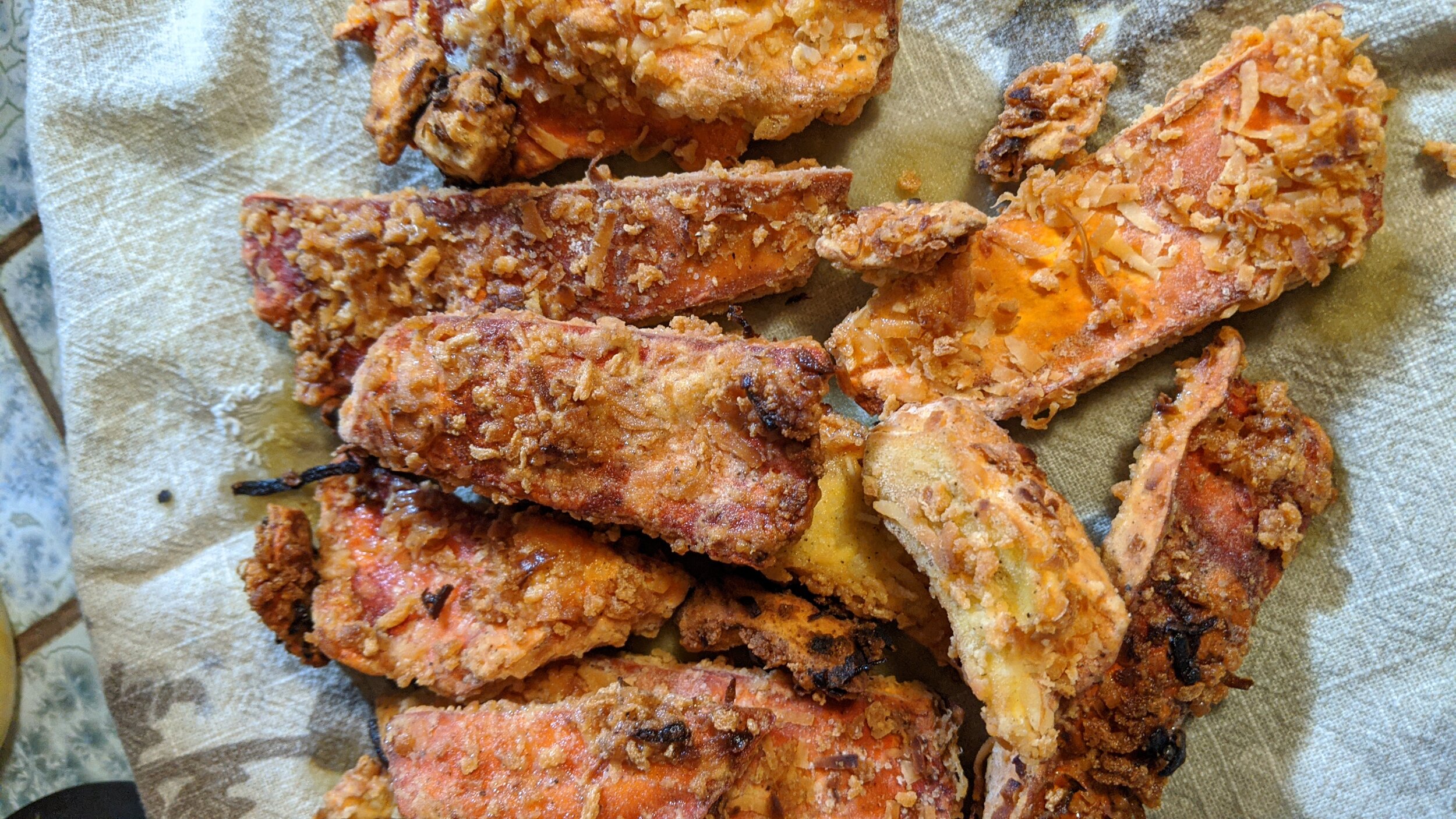
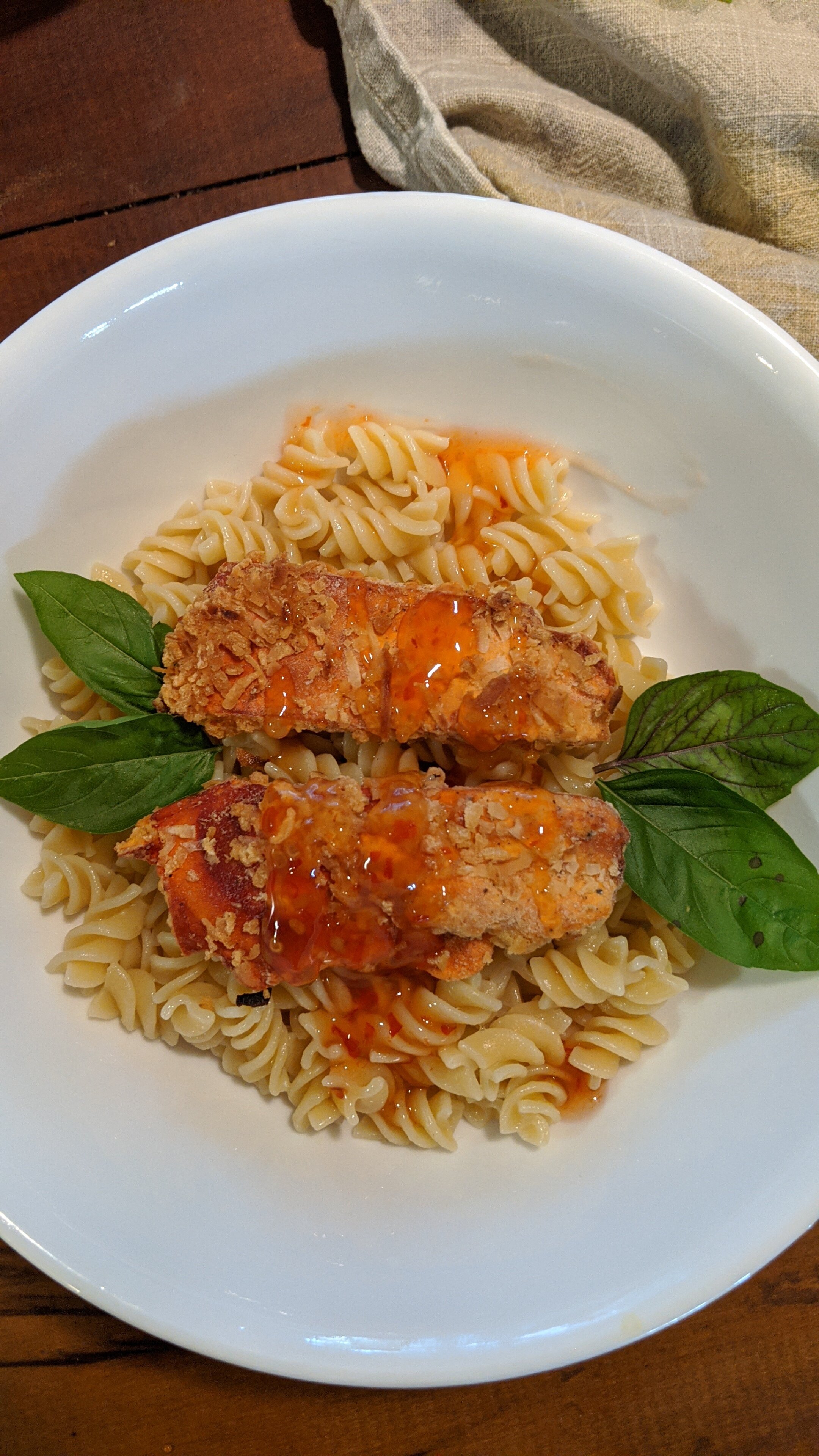
Recipe: Coconut Chicken of the Woods
Coconut Chicken-of-the-Woods is a delicious way to prepare this choice edible mushroom.
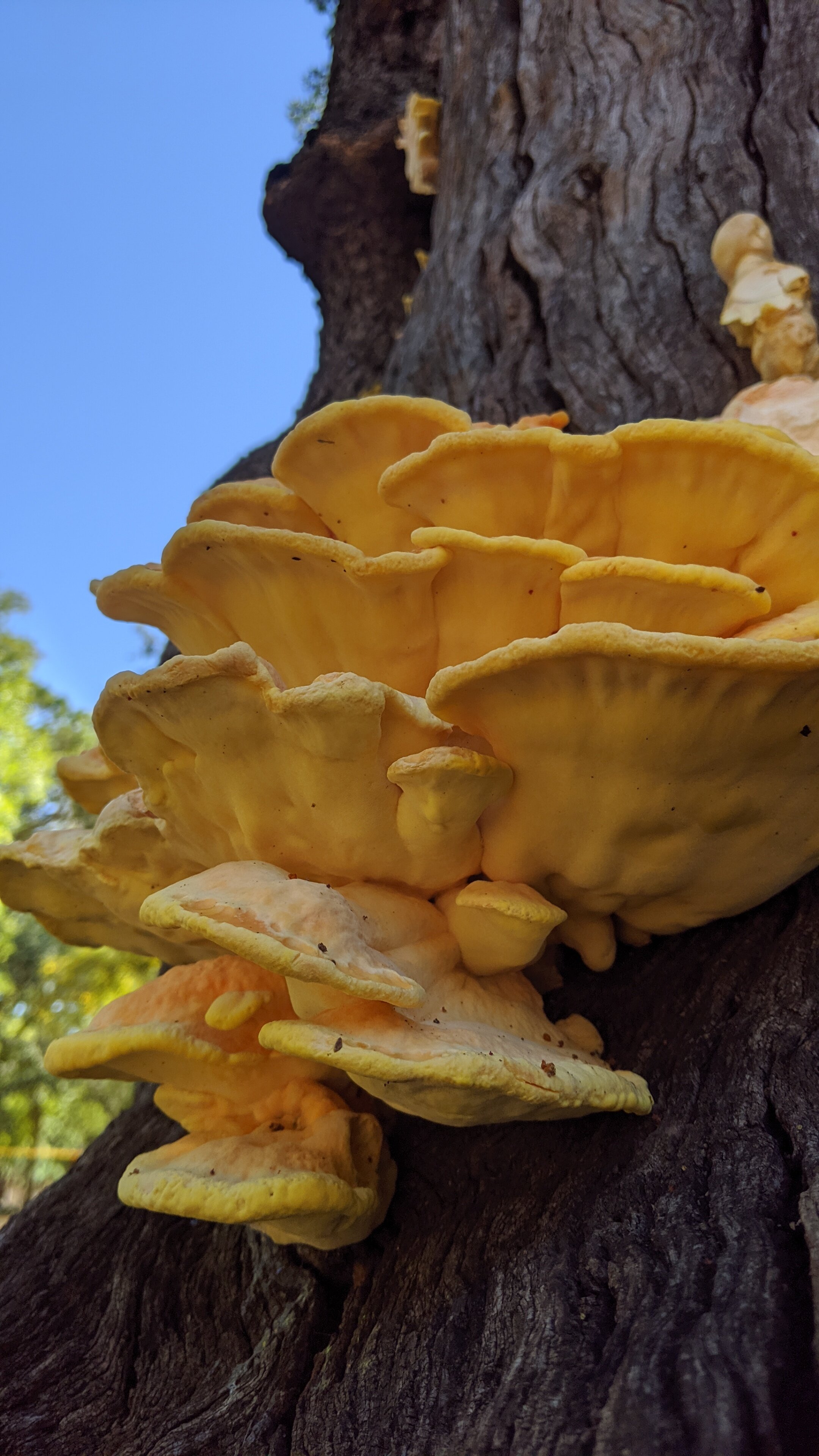
Chicken of the Woods or Laetiporus species is choice edible and is highly nutritious fungi making it a great addition to a meat free diet. 100g of the mushroom contains 14g of protein, 6g of carbs, 3g of fiber and 150mg of potassium. In addition, it is rich in antioxidants, including flavonoids and phenols. These antioxidants have many medicinal benefits, such as anti-inflammatory, anti-viral, and anti-cancer properties. Since it doesn’t have any toxic look-a-likes, it is also a safe and mushroom to forage for beginners.
Coconut Chicken-of-the-Woods is my favorite way to prepare it.
Ingredients
1/3 cup all-purpose flour or whole wheat flour (spoon & leveled)
1/2 teaspoon salt
1/2 teaspoon ground black pepper
1/2 teaspoon red pepper
2 large eggs, beaten
3/4 cup Panko bread crumbs
1 cup sweetened shredded coconut
1 pound Chicken-of-the-Woods
Coconut Oil (Enough to fill frying pan 1 inch)

Instructions
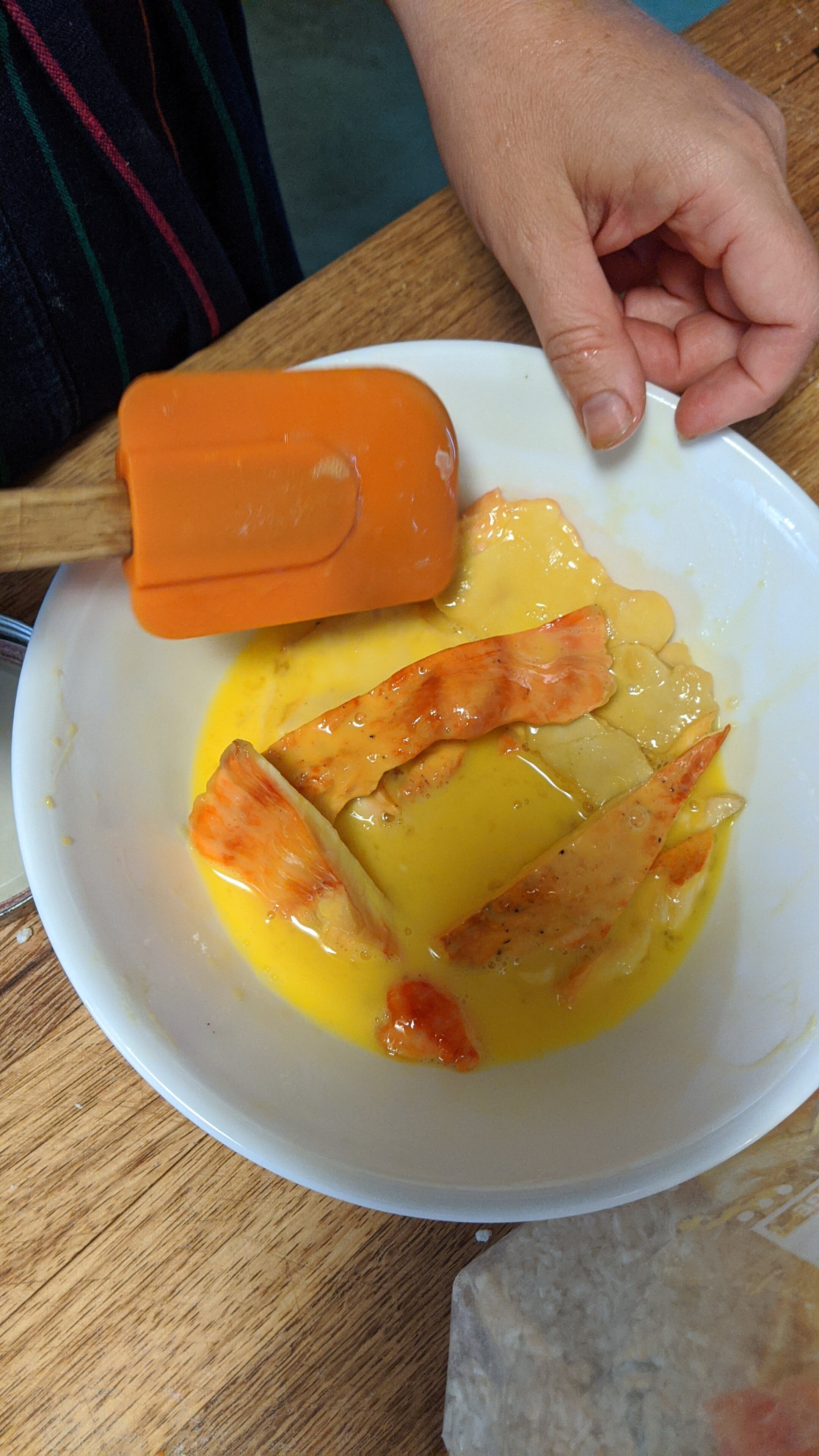
Hand pull mushroom into strips or nuggets.
Dry sauté the pieces with 1/4 cup of water, salt and vinegar in a fry pan until water is absorbed or for 15 minutes. Drain excess water and use for broth, etc.
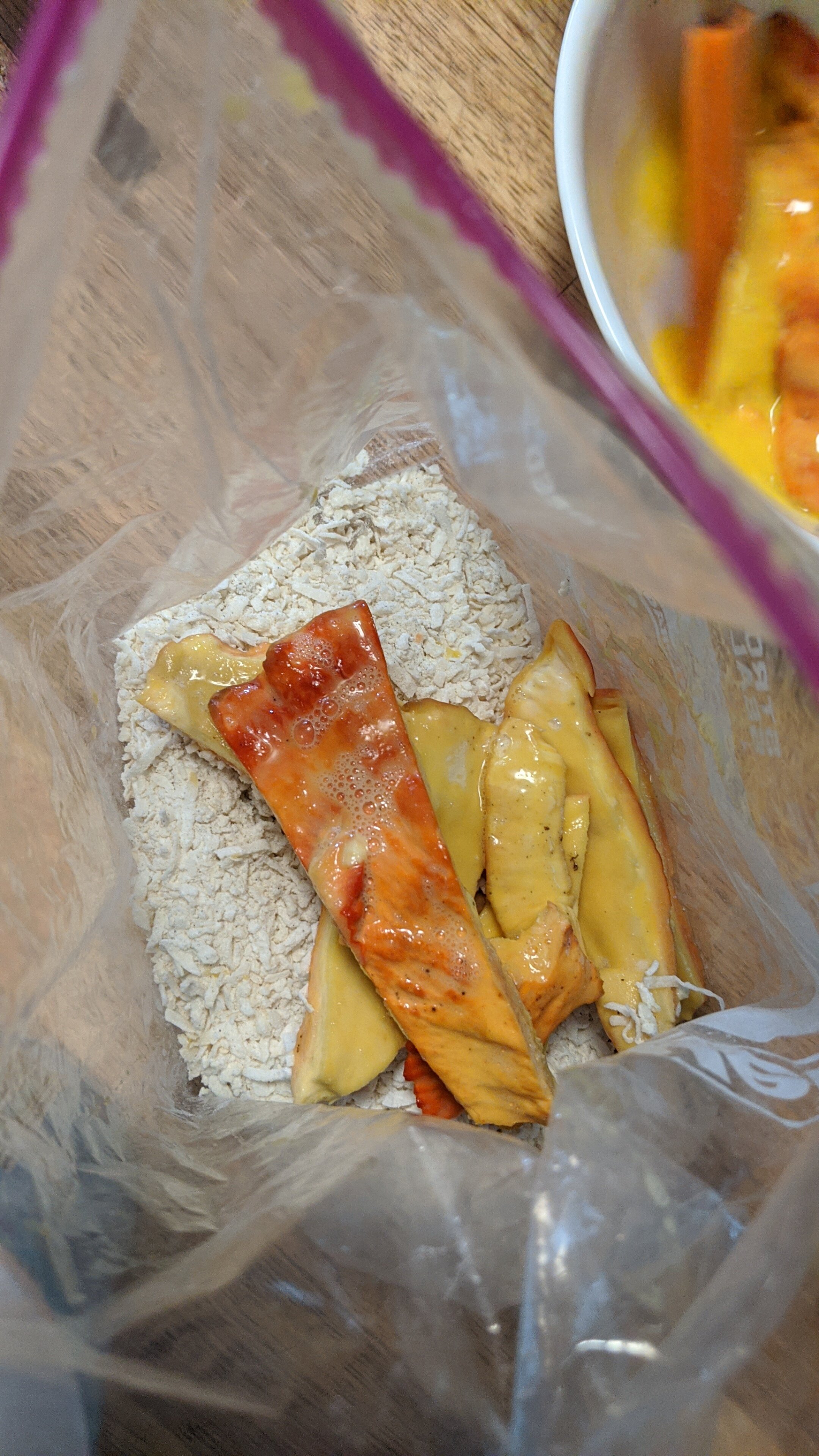
Combine flour, salt, and spices in one bowl. In a second bowl beat the eggs. Combine panko and coconut in the third bowl or large plastic freezer bag.
Dip the COW into the first bowl of flour and spices, then dredge in eggs, and then put the COW into the coconut and panko breading that is in a freezer bag and shake up.
Set the coated COW aside on a plate as you coat the remainder.
Add enough oil to cover the bottom of a large skillet on medium heat. Fry the coconut COW in batches – do not crowd them in the pan. I fried about 6-7 at a time. Flip after 2 minutes and fry the other side for 2 minutes or until golden brown. I like mine a little darker, so I fried each side for about 3 minutes.
Place the finished coconut COW on a plate lined with a towel as you fry the rest. Serve with your favorite sweet Thai chili sauce or an orange chili sauce.
Serve on top of your favorite pasta (optional) and sprinkle with a little chopped cilantro or basil (optional) and serve.
About Chicken-of-the-Woods
Scientific Name: Laetiporus sulphureus
Common Name: Chicken-of-the-Woods, Sulphur Shelf
Family: Polyporaceae
Description: Orange to yellow polypore, with yellow or white pores on underside.
Habitat: Grows in shelfs on heartwood of dead or dying oaks.
Spore Color: White Size: 6-12" width
Edibility: Contains proteins, fat, fiber and tastes just like chicken! Harvest when young, colorful, and moist. Becomes lighter in color, fiborus, mealy and dry, inedible with age.
Look-alikes: Shaggy Bracket, Inonotus hispidus (non-toxic)
Learn more about foraging it here.

October Mushroom of the Month: Laetiporus sp
The Mushroom of the Month for October is Laetiporus, aka Chicken of the Woods

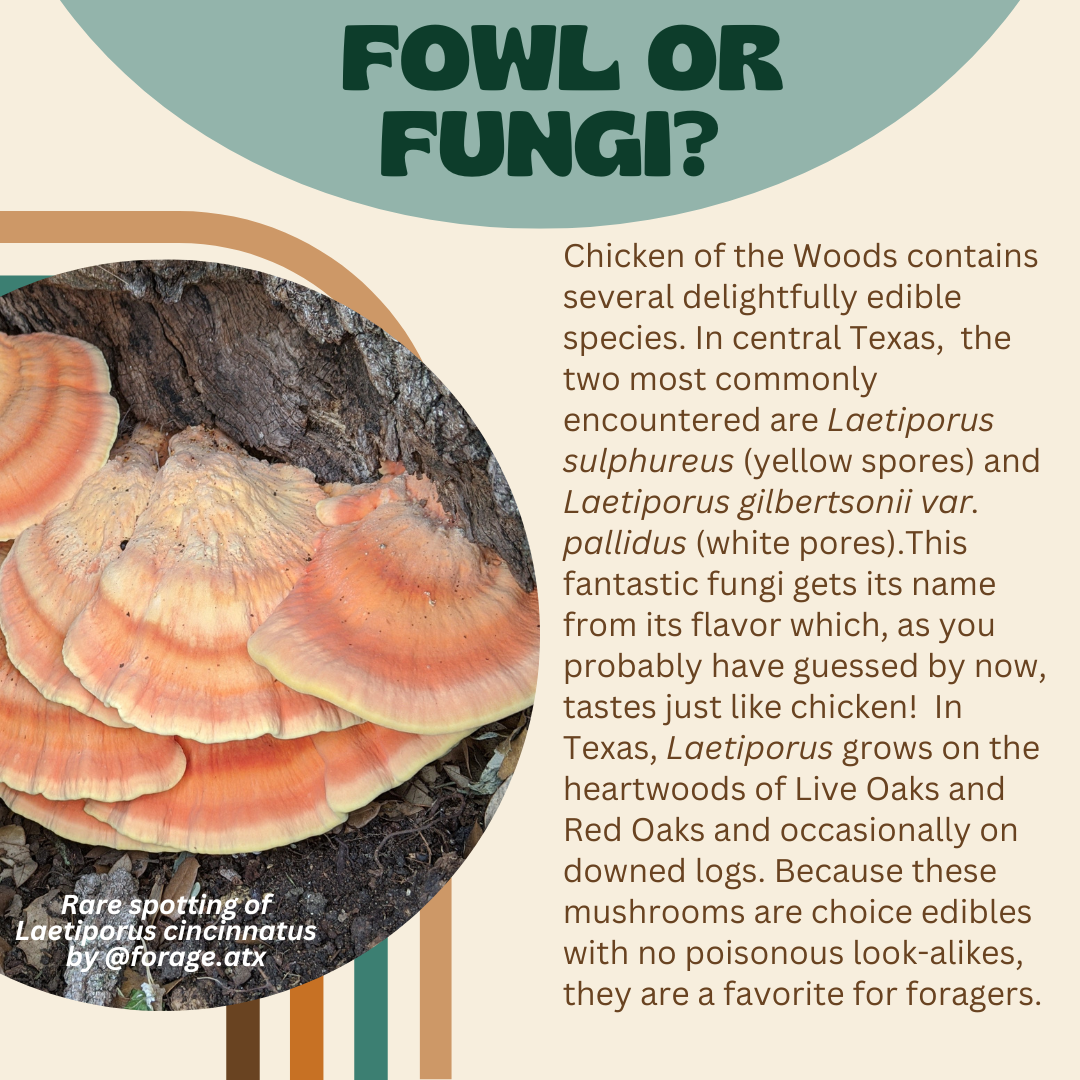


🐔🍄🌳The October mushroom of the month is 𝘓𝘢𝘦𝘵𝘪𝘱𝘰𝘳𝘶𝘴 commonly known as Chicken of the Woods! This choice edible mushroom that can be found perching in oak trees in the fall.
🙌 to Barb Danko for naming that mushroom correctly and becoming the 1,312th member of Central Texas Mycology!
You can also be a supporting member to stay dialed-in with events & discover next month’s mystery mushroom.
FOWL OR FUNGI?
Chicken of the Woods contains several delightfully edible species. In central Texas, the two most commonly encountered are Laetiporus sulphureus (yellow spores) and Laetiporus gilbertsonii var. pallidus (white pores).This fantastic fungi gets its name from its flavor which, as you probably have guessed by now, tastes just like chicken! In Texas, Laetiporus grows on the heartwoods of Live Oaks and Red Oaks and occasionally on downed logs. Because these mushrooms are choice edibles with no poisonous look-alikes, they are a favorite for foragers.
FRIEND OR FOE?
Despite their popularity amongst fungal enthusiasts, Laetiporus is considered to be a nuisance by some arborists. This is mostly due to its status as a parasitic species that promotes brown rot in its host. However, evidence has shown that Laetiporus does not live up to its bad rap. In fact, Laetiporus is actually a cubical brown rot fungi (slow decomposer) and provides habitat for bees and other creatures as it slowly decomposes trees. It has been found growing on thriving 500+ year old live oak trees, proving that the relationship between fungi and host may be more symbiotic than parasitic.
edible + Medicinal
Chicken of the Woods is a highly nutritious fungi making it a great addition to a meat free diet. 100g of the mushroom contains 14g of protein, 6g of carbs, 3g of fiber and 150mg of potassium. In addition, it is
rich in antioxidants, including flavonoids and phenols. These antioxidants have many medicinal benefits, such as anti-inflammatory, anti-viral, and anti-cancer properties. Since it doesn’t have any toxic look-a-likes, it is also a safe and mushroom to forage for beginners.
BECOME A SUPPORTING MEMBER & stay Dialed in with events & discover next month’s mystery mushroom

Benefits of Green Mold, AKA Trichoderma Fungi
Trichoderma or Green Mold is a soil dwelling fungi found all over the world that causes problems in sterile mushroom farms. If a mushroom block has green mold growing on it, it’s not a loss. It actually benefits plants in the following ways:

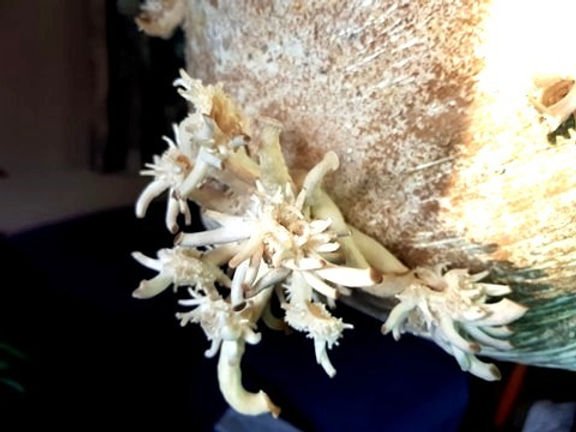
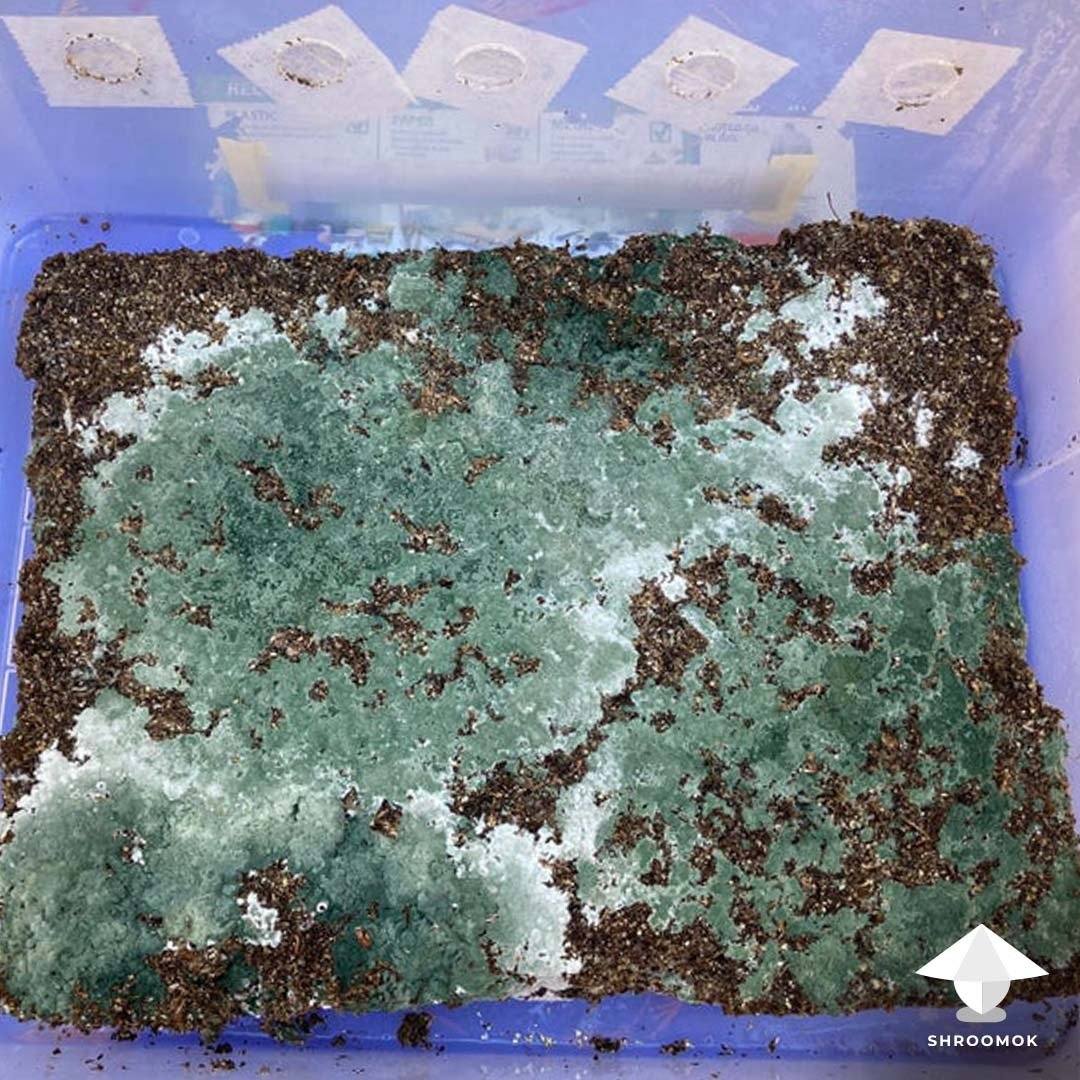


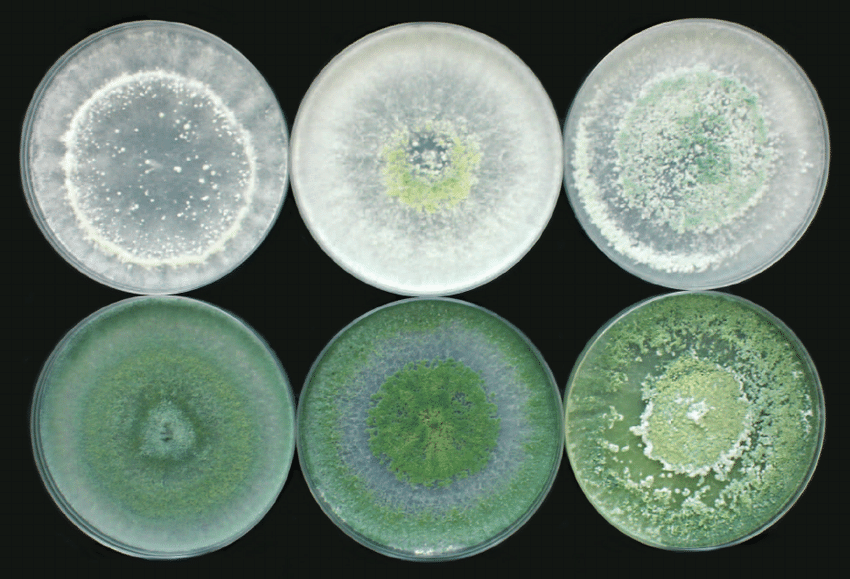
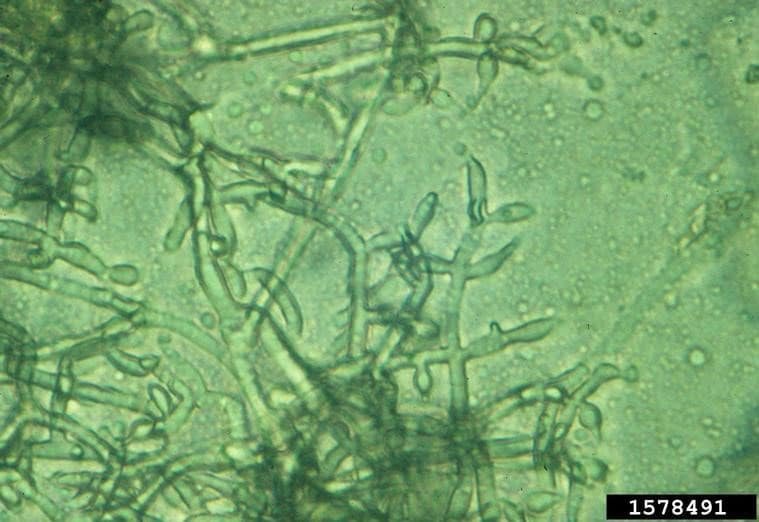
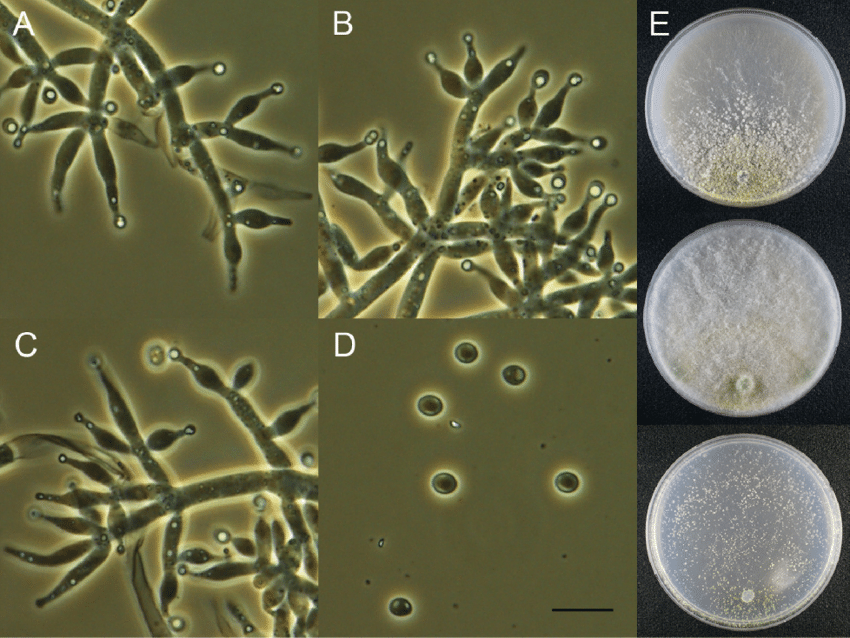
Trichoderma or Green Mold is a soil dwelling fungi found all over the world that causes problems in sterile mushroom farms. If a mushroom block has green mold growing on it, it’s not a loss. It actually benefits plants in the following ways:
Root Development: Trichoderma produces growth-promoting hormones like indole acetic acid (IAA), which stimulate root growth, leading to a more extensive and healthy root system. This allows trees to access more water and nutrients.
Enhanced Nutrient Uptake: Trichoderma forms a symbiotic relationship with tree roots, enhancing the absorption of nutrients, especially nitrogen, phosphorus, and essential micronutrients. This promotes better tree growth and vigor.
Disease Suppression: Trichoderma helps trees fight off pathogens by parasitizing harmful fungi and secreting enzymes that break down pathogen cell walls. This protects the tree from diseases, allowing it to grow without stress.
Stress Resistance: It boosts the tree's ability to withstand abiotic stresses like drought and salinity by producing compounds that enhance the plant’s stress tolerance mechanisms.
Soil Health: Trichoderma improves soil structure and fertility by breaking down organic matter and promoting microbial diversity, creating a better growing environment for trees.
Source: https://doi.org/10.1016/B978-0-12-822919-4.00003-X